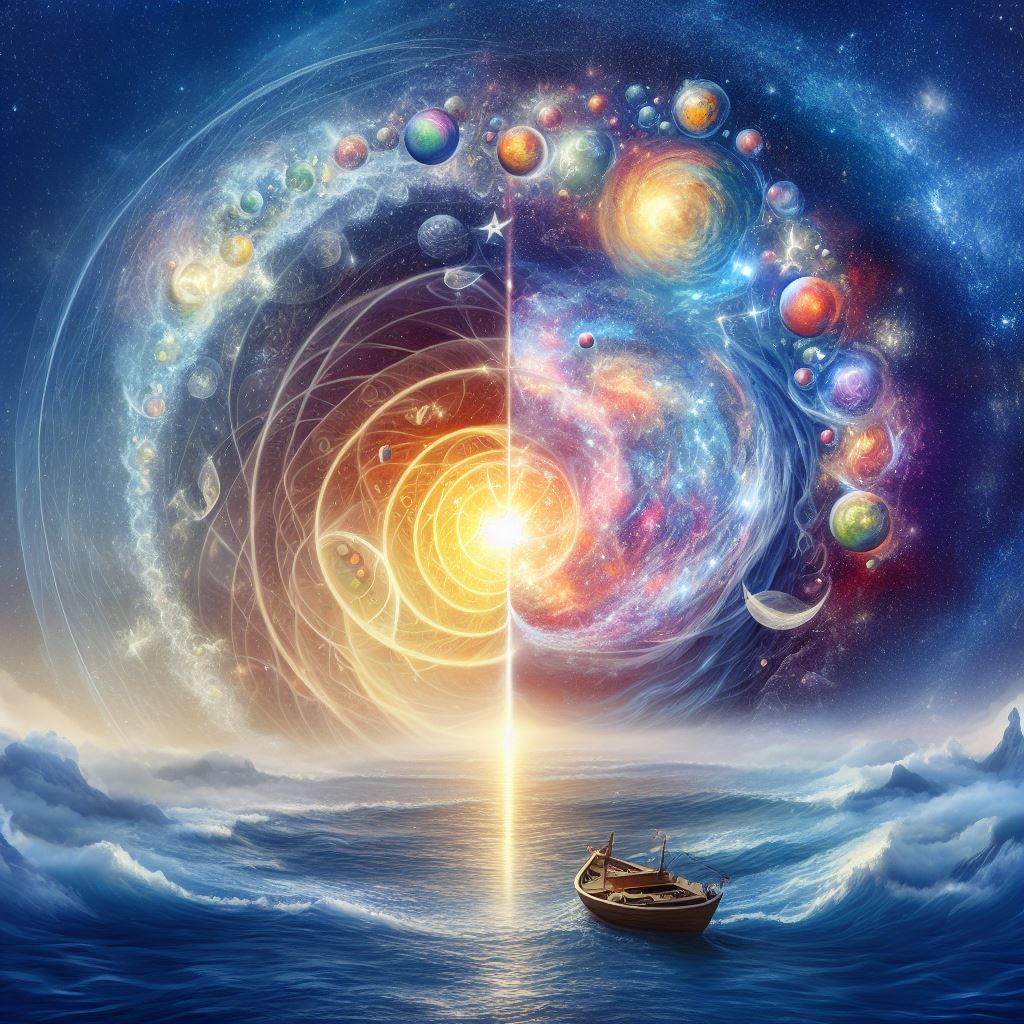
The universe, a profound subject of exploration uniting both science and religion, beckons us to uncover its mysteries. In Surah Al-Anbiya (21:30) of the Holy Qur’an, a verse that resonates across millennia, we find divine wisdom and inspiration:
“Have not those who disbelieve known that the heavens and the earth were joined together as one united piece, then We parted them? And We have made from water every living thing. Will they not then believe?” ¹
In these words, we glimpse the origin of the universe, a singular entity cleaved by the command of the Almighty, with water emerging as the wellspring of all life. This raises the question: How does this ancient verse align with contemporary scientific theories regarding the universe’s birth and evolution?
One compelling perspective links this verse to the Big Bang theory, the prevailing scientific narrative of the universe’s inception. This theory proposes that the cosmos originated from a dense, searing state, rapidly expanding and cooling over eons. This initial singularity could be likened to the “one united piece,” dramatically “parted” by a cosmic explosion. It hints at the idea that the heavens and the earth were not initially distinct entities but part of the same expansive space.
Alternatively, we may consider this verse as a metaphorical testament to the divine creative force and wisdom rather than a literal historical account. It conveys the power of God to create from nothingness and to breathe life into the inanimate. It places water at the heart of existence, emphasizing its role as a fundamental element for life, a symbol of God’s benevolence.
Hazrat Mirza Bashiruddin Mahmood Ahmad, the second caliph and leader of the Ahmadiyya Muslim Community, offered profound insights into this verse. He saw it as an argument for the oneness of God and a challenge to disbelievers. It prophesied that humanity would come to realize that all living beings stem from water, confirming the Quran’s truth. Moreover, it invited skeptics to rival the Quran or demonstrate the creation of life from water or other materials. ²
Remarkably, he highlighted that modern science has unveiled the composition of living beings, primarily water, and affirmed that life’s origins are rooted in aquatic realms. Thus, this verse not only attests to the Quran’s divine origin but also provides timeless guidance. It aligns the ancient text with contemporary knowledge, reinforcing the harmonious relationship between faith and science.²
In the interplay of science and spirituality, we find resonance between Surah Al-Anbiya and our ever-expanding understanding of the universe. This ancient verse continues to inspire and challenge us, inviting us to explore the profound connections between the cosmos and the divine. It is a reminder that the pursuit of knowledge can be a spiritual journey, an ode to the wonders of creation, and a testament to the unity of faith and reason.
 Radio VOIB