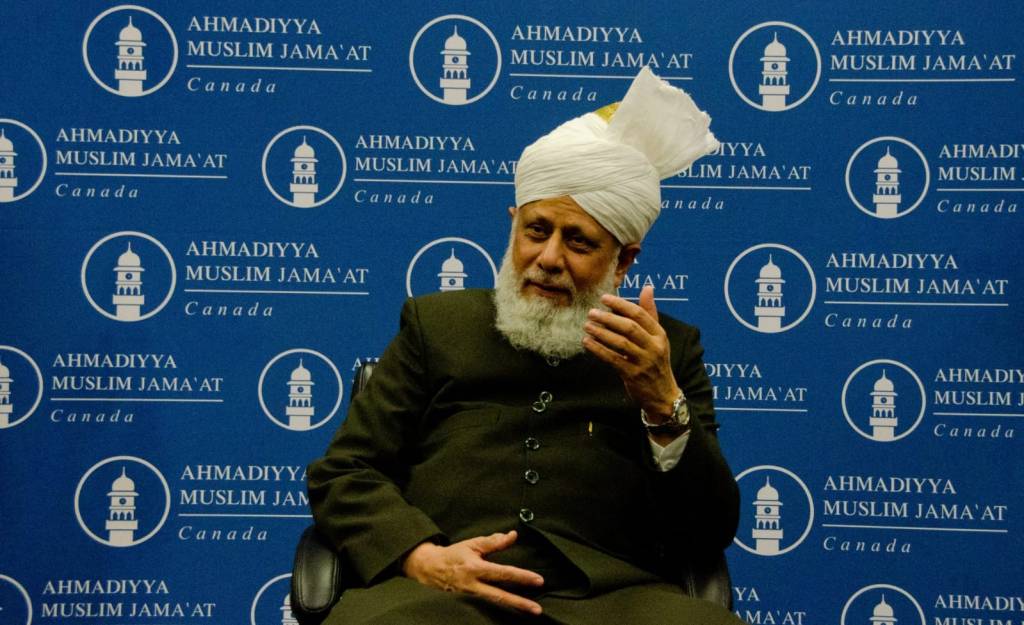
Hazrat Mirza Masroor Ahmad
The war between Israel and Gaza is a complex and protracted conflict that has its roots in the history, politics, and religion of the region. The current escalation of violence began on October 7, 2023, when Hamas, the militant group that controls the Gaza Strip, launched a series of cross-border attacks on Israel, killing around 1,200 people, mostly civilians, in the deadliest attack in Israel’s history. Israel responded with a massive aerial and ground offensive, targeting Hamas’s military infrastructure, rocket launchers, and tunnels, as well as civilian buildings and infrastructure in Gaza. The Israeli bombardment has killed more than 10,000 Palestinians, mostly civilians, and displaced hundreds of thousands more2. The humanitarian situation in Gaza is dire, as the enclave faces shortages of food, water, fuel, electricity, and medical supplies, and is under a blockade imposed by Israel and Egypt3.
The international community has been calling for an immediate and lasting ceasefire, as well as a political solution to the underlying causes of the conflict. The United Nations, the United States, the European Union, the Arab League, and other countries and organizations have been involved in diplomatic efforts to de-escalate the situation and facilitate humanitarian aid to Gaza. However, these efforts have faced many challenges and obstacles, such as the lack of trust and communication between the parties, the divergent interests and agendas of the regional and global actors, the internal divisions and dynamics within Israel and Palestine, and the absence of a viable peace process that addresses the core issues of the conflict, such as the status of Jerusalem, the borders and security of Israel and Palestine, the Israeli settlements in the West Bank, and the fate of Palestinian refugees.
To stop the war and make permanent peace in this region, it is essential to address both the immediate and the long-term needs and aspirations of both sides. On the immediate level, a ceasefire agreement should be reached that ensures the cessation of hostilities, the release of hostages, the lifting of the blockade, and the delivery of humanitarian aid to Gaza. On the long-term level, a comprehensive peace agreement should be negotiated that establishes two sovereign and democratic states, Israel and Palestine, living side by side in peace and security, based on the pre-1967 borders, with mutually agreed land swaps, and with Jerusalem as the shared capital of both states. Such an agreement should also guarantee the rights and dignity of both peoples, and provide a just and agreed solution for the Palestinian refugees, in accordance with international law and relevant UN resolutions.
To achieve this vision, it is necessary to have strong political will and leadership from both sides, as well as active and constructive involvement from the international community, especially the United States, which has a unique role and influence in the region. It is also important to have the support and participation of the civil society, the media, the religious leaders, and the public opinion of both sides, as well as the wider region, to foster a culture of dialogue, tolerance, and coexistence. Peace is possible for Israel and Gaza, if their leaders and people want it, and if they are willing to make the necessary compromises and sacrifices for the sake of a better future for themselves and their children.
Hazrat Mirza Masroor Ahmad, the world head of the Ahmadiyya Muslim Community, has given several advice to resolve the war between Israel and Gaza. Here are some of his main points:
He has called on the world powers, especially the United States, to exercise restraint and play a constructive role in bringing about a ceasefire and a political solution to the conflict. He has warned that if the world powers continue to support the oppression of the Palestinians and ignore their rights, the war could spread throughout the region and even globally.
He has urged the Muslim nations to unite and speak with one voice in support of the Palestinians and against the injustice and aggression of Israel. He has said that if the Muslim countries were to act in harmony and solidarity, they would have a significant impact on the world and could establish peace in the region.
He has condemned the killing of innocent civilians on both sides and expressed his sympathy and prayers for the victims and their families. He has said that Islam teaches the sanctity of human life and forbids the indiscriminate killing of any person, regardless of their religion or nationality.
He has criticised the Western media for their biased and one-sided coverage of the war, which portrays Israel as the victim and Hamas as the aggressor, while ignoring the plight and suffering of the Palestinians. He has said that the media should be fair and objective and report the facts and the truth, not the propaganda and the lies.
He has made an urgent call for concerted prayers for the end of the war and the establishment of peace and justice in the region. He has said that prayer is the most powerful weapon of the believers and that only God can change the hearts and minds of the oppressors and the oppressed. He has asked the members of the Ahmadiyya Muslim Community and all peace-loving people to pray earnestly for the sake of humanity and the world.
These are some of the advice that Hazrat Mirza Masroor Ahmad has given to resolve the war between Israel and Gaza. He has shown a deep concern and compassion for the situation and has offered a peaceful and rational way to end the violence and achieve a lasting peace in the region. He has also demonstrated his leadership and wisdom as the head of the Ahmadiyya Muslim Community, which is a global movement that strives to revive the true teachings of Islam and promote the values of love, tolerance, and service to humanity.
 Radio VOIB