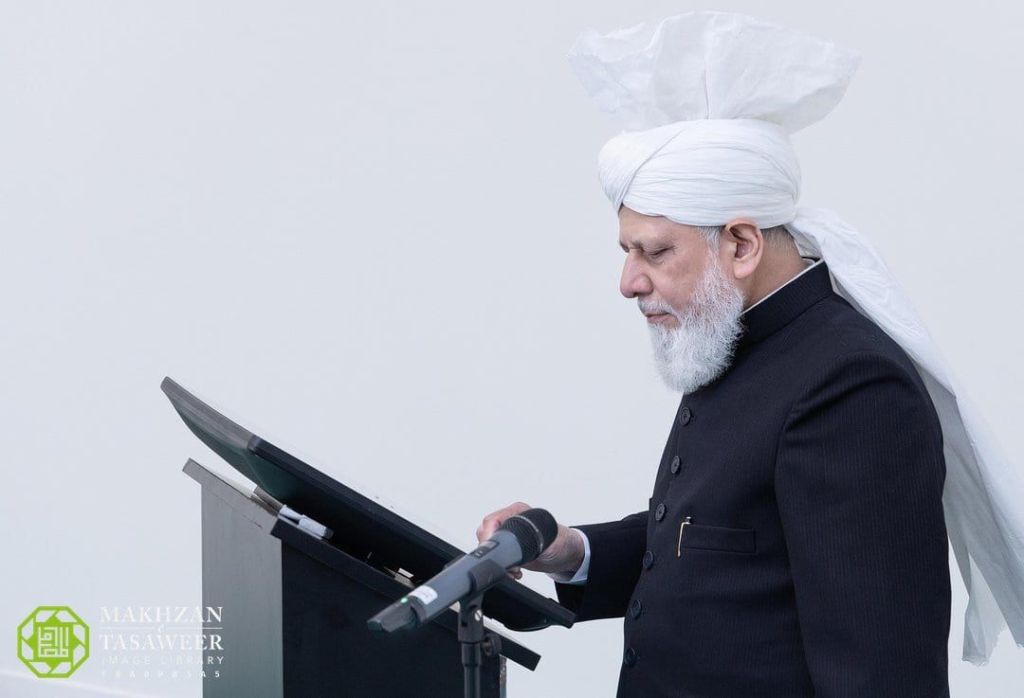
In the Friday sermon on August 16, 2024, Hazrat Mirza Masroor Ahmad, Khalifatul Masih V (aba), delved into profound lessons from Islamic history that resonate powerfully in today’s world. His Holiness discourse, rooted in the life and example of the Holy Prophet Muhammad (SA), not only serves as a reminder of the moral and spiritual fortitude required of believers but also sheds light on the timeless values of justice, compassion, and integrity.
The sermon revisited the Expedition of Banu Mustaliq, an event rich in spiritual and moral teachings. It highlighted the Prophet’s (sa) forward-thinking leadership, where even amid a military expedition, he was attuned to the community’s needs. Establishing a grazing ground for the poor, with boundaries determined by the reach of the call to prayer, is a striking example of how spiritual and practical wisdom were intertwined in the Prophet’s (sa) governance. This act underscores the importance of equitable resource distribution and care for the less privileged, a principle that remains pertinent in the socio-economic challenges of the modern world.
Moreover, His Holiness (aba) recounted the lighthearted yet meaningful interactions of the Prophet (sa) with his companions and family. The Prophet’s (sa) organization of competitions among his companions served not only as a means of maintaining morale but also as a tool for fostering courage, camaraderie, and moral training. The narration of his race with Hazrat A’ishah (ra) is particularly telling, revealing the Prophet’s (sa) deep affection and playful spirit within his household. This account is a poignant reminder that kindness and joy within family life are not only permissible but are integral to the Islamic way of life. It also challenges the stereotypes of harshness and distance that have, unfortunately, been associated with Islamic marital relations by some.
However, the sermon’s most compelling segment was the recounting of the Great Calumny (Ifk), an incident that tested the resilience and faith of Hazrat A’ishah (ra) and the Holy Prophet (sa) himself. The false allegations against Hazrat A’ishah (ra) and the Prophet’s (sa) handling of the situation provide an enduring lesson in patience, trust in divine justice, and the importance of truth. Despite the pain and uncertainty caused by the vicious rumors, the Prophet (sa) maintained his composure and sought counsel, demonstrating that even in the face of slander, a leader must act with wisdom and fairness. The eventual exoneration of Hazrat A’ishah (ra) through divine revelation reaffirms the belief that truth and innocence, though sometimes clouded by human malice, will ultimately prevail.
His Holiness (aba) also extended a heartfelt appeal for prayers for the oppressed and suffering in various parts of the world, including Bangladesh, Pakistan, and Palestine. This call for prayers is a sobering reminder of the ongoing struggles faced by many in the Muslim world. His Holiness’ words challenge leaders to reflect on their roles, urging them to embody justice rather than perpetuate oppression. It is a stark reminder that the unity and integrity of the Muslim Ummah are contingent upon the righteousness of its leaders and the justice they uphold.
In a world rife with challenges—be they social, political, or personal—the teachings of the Holy Prophet (sa) as highlighted by Hazrat Mirza Masroor Ahmad (aba) serve as a beacon of guidance. They remind us that steadfastness in faith, commitment to justice, and compassion for others are the pillars upon which a just and harmonious society is built. As we reflect on these lessons, let us strive to embody these values in our daily lives, ensuring that we, too, contribute to the betterment of our communities and the world at large.”
#bangla #Bangladesh #Banglanews #bangladesh #Bangladeshstudents #bangla #banglagram #bangladeshi #banglaquotes #bangladeshivlogger #bangladeshquothamovement
 Radio VOIB