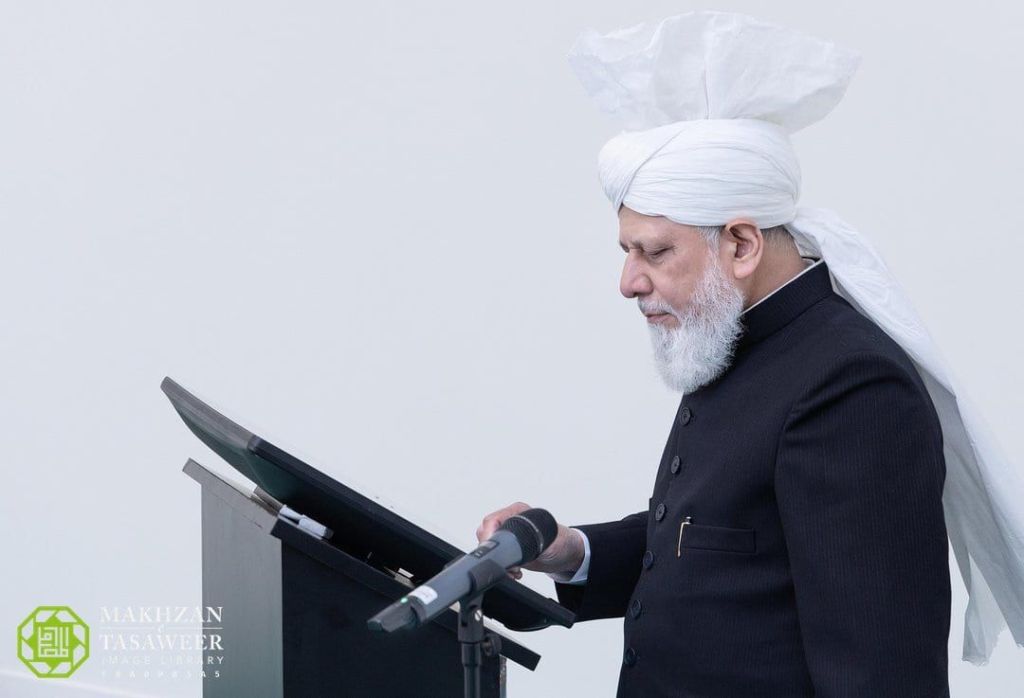
In an era marked by geopolitical conflicts, growing economic disparity, and fractured international relationships, the words of Hazrat Mirza Masroor Ahmad, the Fifth Caliph of the Ahmadiyya Muslim Community, resonate with profound clarity. His keynote addresses offer not just a critique of global leadership but also a comprehensive blueprint for fostering global peace, justice, and moral accountability—a stark contrast to the tumultuous state of contemporary politics.
The backdrop to this discussion is the global reaction to the re-election of Donald Trump as the President of the United States. While media discourse fixates on his pledges of isolationist policies and the restructuring of alliances, Hazrat Mirza Masroor Ahmad’s perspective transcends political boundaries. His guidance calls upon world leaders to rise above self-serving agendas and instead embrace policies rooted in equity, mutual respect, and the betterment of humanity.
A Call for Moral Leadership
Hazrat Mirza Masroor Ahmad has consistently emphasized that the true measure of leadership lies in its ability to uphold justice and serve humanity. Reflecting on the challenges posed by leaders prioritizing economic protectionism over global welfare, he cautions against policies that deepen divisions and exacerbate conflicts. “No nation can achieve lasting success at the expense of others,” he asserts, urging leaders to champion policies that bridge divides rather than create them.
This approach starkly contrasts with President Trump’s rhetoric of “America First,” which often positions national interest as a zero-sum game against global cooperation. Hazrat Mirza Masroor Ahmad’s teachings remind us that in a deeply interconnected world, global peace and national prosperity are not mutually exclusive but deeply interdependent.
Justice: The Pillar of Peace
Central to Hazrat Mirza Masroor Ahmad’s vision is the principle of justice, which he identifies as the cornerstone of any peaceful society. Addressing conflicts such as the Russia-Ukraine war or the enduring strife in the Middle East, he emphasizes dialogue over dominance. His guidance encourages equitable negotiations that respect the dignity and sovereignty of all parties involved, rejecting solutions rooted in coercion or exploitation.
President Trump’s approach to conflict resolution—be it his claim to end the Ukraine war “in a day” or his aggressive policies in the Middle East—raises critical questions about the depth and sustainability of such promises. Hazrat Mirza Masroor Ahmad’s perspective, grounded in spiritual insight and practical wisdom, highlights that enduring peace cannot be imposed; it must be nurtured through justice and empathy.
Building Bridges in a Divided World
In the realm of international diplomacy, Hazrat Mirza Masroor Ahmad’s vision advocates for building bridges rather than walls. His critique of unilateralism is particularly relevant in the context of NATO, Middle Eastern conflicts, and U.S.-China relations. Where leaders like President Trump have at times viewed alliances as transactional, Hazrat Mirza Masroor Ahmad calls for partnerships based on shared values and mutual benefit.
His emphasis on addressing the root causes of conflict—such as economic inequality, political marginalization, and cultural misunderstanding—presents a holistic alternative to short-term, reactionary policies. The Ahmadiyya Muslim Community’s global humanitarian efforts are a testament to this philosophy, demonstrating that unity and service are not mere ideals but achievable realities.
A Vision of Hope
Amidst the uncertainties of modern geopolitics, Hazrat Mirza Masroor Ahmad offers a vision of hope grounded in faith and humanity. His calls for moral accountability, justice, and cooperation challenge leaders and individuals alike to transcend narrow self-interest. “True peace,” he asserts, “can only be achieved when the powerful and the weak alike uphold the same principles of honesty, equity, and compassion.”
In a world grappling with the consequences of divisive leadership and unmet promises, Hazrat Mirza Masroor Ahmad’s guidance serves as a beacon for all who seek a brighter, more harmonious future. His vision compels us to ask: Will our leaders rise to this challenge, or will we remain mired in cycles of conflict and mistrust? The answer lies in our collective willingness to embrace the transformative power of justice and unity.
 Radio VOIB