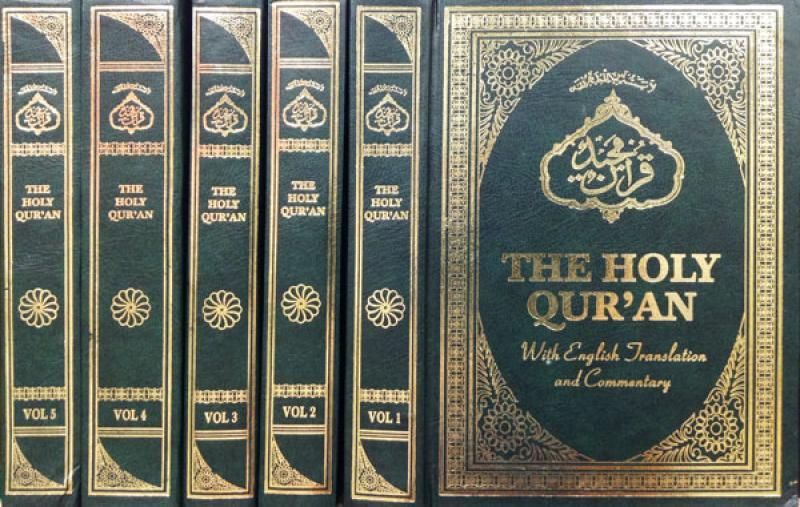
The allegations claiming that the Holy Qur’an contains inconsistencies regarding the concept of leadership and governance have been raised by some critics. However, when analyzed deeply in light of the Tafsir-e-Kabir and the Five Volume Commentary by Hazrat Mirza Bashiruddin Mahmood Ahmad (ra), along with insights from political and social sciences, these allegations are found to be baseless. The Qur’an provides a coherent, timeless, and comprehensive framework for leadership and governance that emphasizes justice, consultation, accountability, and moral integrity. Below is a detailed refutation of these allegations point by point.
—
1. Allegation: Contradictory Views on Governance Structures
Claim: Critics argue that the Qur’an does not clearly prescribe a definitive structure for governance, leaving room for contradictions.
Refutation:
The Qur’an provides principles, not rigid structures, allowing adaptability across different times and cultures. This flexibility ensures its applicability to diverse sociopolitical systems.
Key Principle – Consultation (Shura):
The Qur’an emphasizes consultative governance:
> “And those who have responded to their master, and establish prayer, and their affairs are decided by mutual consultation among themselves…” (Surah Ash-Shura, 42:39).
This principle forms the foundation of democratic practices. Leadership based on consultation aligns with the principles of modern political science, which stresses participatory governance.
Tafsir-e-Kabir elaborates that the Qur’anic Shura system promotes justice and ensures inclusivity while avoiding the rigidity that might stifle progress.
Flexible Leadership Framework:
While it does not dictate a single political system, the Qur’an emphasizes the qualities of leaders:
“Indeed, Allah commands you to render trusts to whom they are due and when you judge between people to judge with justice…” (Surah An-Nisa, 4:58).
This ensures that governance is adaptable to various sociopolitical contexts while rooted in universal principles of justice and accountability.
—
2. Allegation: Monarchical vs. Non-Monarchical Governance
Claim: Critics argue that the Qur’an appears to endorse monarchy in some verses (e.g., references to Prophets David and Solomon) while advocating for egalitarian principles elsewhere.
Refutation:
Prophets David and Solomon’s Leadership:
The Qur’an mentions them not as monarchs in the conventional sense but as divinely guided leaders exemplifying justice and humility.
Their governance was deeply rooted in servitude to God and the welfare of their people. Tafsir-e-Kabir explains that their leadership was exceptional, guided by divine revelation, and cannot be compared to hereditary monarchies based on self-interest.
Egalitarianism and Accountability:
The Qur’an consistently upholds equality and accountability, emphasizing that leadership is a trust, not a privilege:
“The best of you is he who is the most righteous among you” (Surah Al-Hujurat, 49:13).
This eliminates the concept of hereditary privilege and focuses on moral and ethical qualifications for leadership.
—
3. Allegation: Inconsistent Criteria for Leadership
Claim: Critics allege that the Qur’an’s criteria for leadership vary, causing confusion.
Refutation:
The Qur’an defines clear and consistent criteria for leadership, which include justice, knowledge, piety, and the ability to govern effectively:
“Said he, ‘Surely the best of men for you to employ is the one who is strong and trustworthy.’” (Surah Al-Qasas, 28:26).
Tafsir-e-Kabir elaborates that “strength” signifies capability, while “trustworthiness” signifies moral integrity, forming a holistic framework for leadership.
Universal Application:
These qualities apply to all forms of governance and leadership, whether individual or collective, ensuring alignment with the principles of good governance outlined in social sciences.
—
4. Allegation: Ambiguity on Succession of Leadership
Claim: Critics claim that the Qur’an is ambiguous about the process of succession in leadership.
Refutation:
Guidance on Succession:
The Qur’an encourages consultation and consensus for succession:
“And those who have believed and done righteous deeds… their rule is by mutual consultation among themselves” (Surah Ash-Shura, 42:39).
The practice of the early Caliphs, as highlighted in Tafsir-e-Kabir, demonstrates the practical application of this principle, where succession was decided through consultation and public approval.
Avoidance of Chaos:
The Qur’an discourages divisiveness in leadership, emphasizing unity and collective responsibility. Modern political systems echo this through peaceful transitions of power and conflict resolution mechanisms.
—
5. Allegation: Lack of Clarity on Leadership Roles
Claim: Critics assert that the Qur’an is vague about the roles and responsibilities of leaders.
Refutation:
Defined Responsibilities:
The Qur’an provides a detailed outline of leadership roles:
Establishing justice: “…judge with justice…” (Surah An-Nisa, 4:58).
Protecting the rights of the weak: “And let not the hatred of a people prevent you from being just…” (Surah Al-Ma’idah, 5:9).
Ensuring welfare: “And We have not sent you, [O Muhammad], except as a mercy to the worlds” (Surah Al-Anbiya, 21:107).
These responsibilities align with the principles of modern governance, including justice, welfare, and inclusivity.
Moral Leadership:
Tafsir-e-Kabir emphasizes that Qur’anic leadership is a moral and spiritual responsibility, ensuring that the leader serves the people rather than seeking personal gain.
—
6. Allegation: Ethical and Practical Challenges
Claim: Critics argue that Qur’anic governance is idealistic and difficult to implement practically.
Refutation:
Ethical Framework for Practical Governance:
The Qur’an integrates ethics with practicality, creating a governance model that is realistic yet principled. Social sciences recognize the importance of ethical leadership for sustainable governance.
The Five Volume Commentary highlights that the Qur’anic approach to justice, consultation, and accountability addresses real-world challenges effectively.
Case Studies in Islamic History:
The early Islamic Caliphate, guided by Qur’anic principles, demonstrated practical success in governance, emphasizing welfare, inclusivity, and justice.
—
Conclusion
The allegations of inconsistencies in the Qur’an’s concept of leadership and governance are unfounded when analyzed comprehensively. The Qur’an provides a timeless framework rooted in justice, consultation, accountability, and ethical governance. The Tafsir-e-Kabir and the Five Volume Commentary of Hazrat Mirza Bashiruddin Mahmood Ahmad (ra) offer profound insights into the coherence and applicability of Qur’anic principles. Furthermore, the integration of these principles with political and social sciences demonstrates their universality and relevance to modern governance systems. Thus, the Qur’an emerges as a source of unparalleled guidance for leadership and governance.
 Radio VOIB