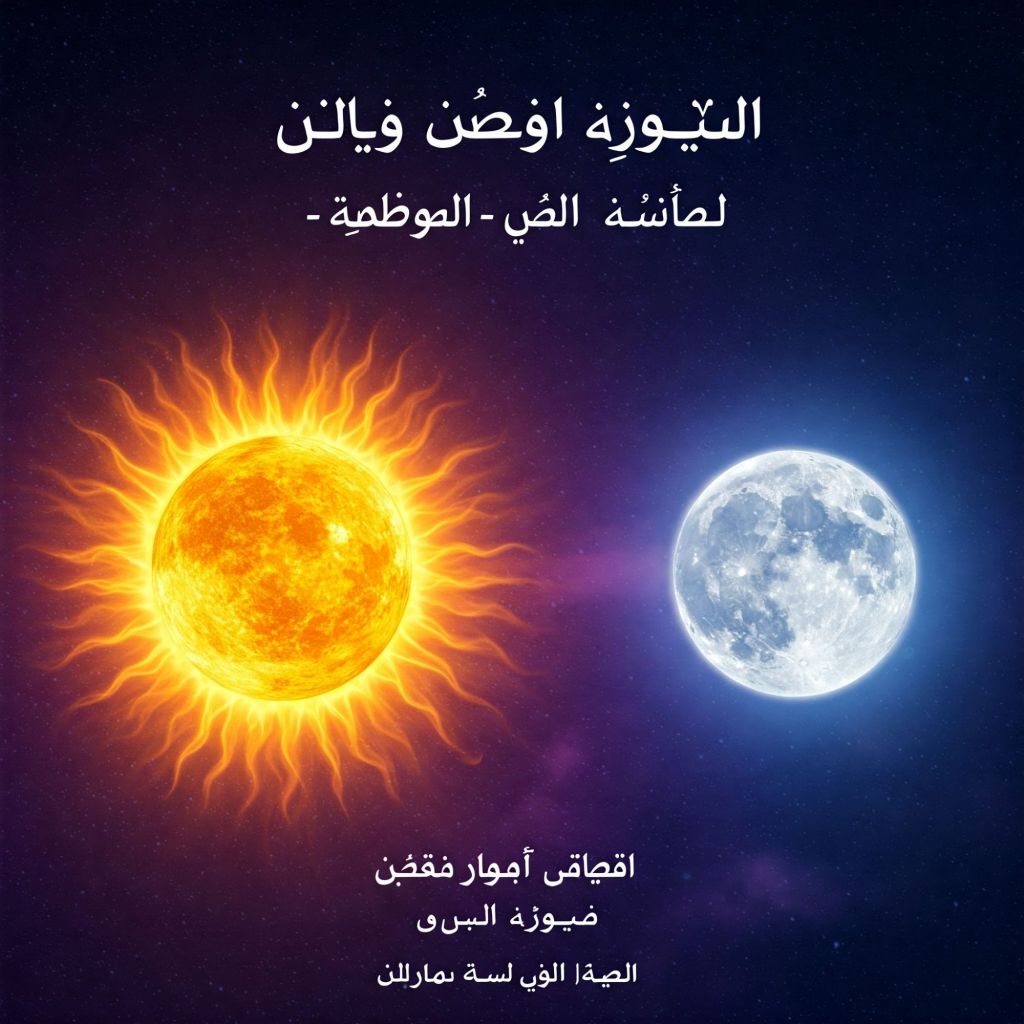
Since the dawn of human consciousness, the sun and the moon have captivated the human intellect. They have been worshipped, revered, studied, and mythologized. But beyond all earthly interpretations, they remain among the most potent symbols of divine precision. Their movement across the heavens is not merely an aesthetic spectacle but a profound testament to a Creator whose wisdom surpasses all imagination.
In Surah Al-Anbiya (21:33), the Holy Qur’an proclaims:
وَهُوَ ٱلَّذِى خَلَقَ ٱلَّيْلَ وَٱلنَّهَارَ وَٱلشَّمْسَ وَٱلْقَمَرَ ۖ كُلٌّۭ فِى فَلَكٍۢ يَسْبَحُونَ
“And it is He who created the night and the day, and the sun and the moon; each floating in an orbit.”
At the time of its revelation, this verse defied human understanding. How could the sun—once thought to be static—be described as moving in an orbit? How could the moon’s motion be so precisely determined? The unfolding of modern scientific discoveries has only reaffirmed the Qur’an’s divine origin, revealing the intricate movements of celestial bodies in ways that astonish even the greatest of astronomers.
The Sun’s Movement – The Grand Dance of the Cosmos
For centuries, scholars believed that the sun was fixed at the center of the universe while celestial bodies revolved around it. However, modern astrophysics has shattered this simplistic view. The sun itself is in perpetual motion, orbiting the galactic center of the Milky Way at an astonishing speed of approximately 828,000 km/h (514,000 mph). It takes around 225 million years to complete a single orbit—a journey it has repeated countless times since its formation.
This movement is not chaotic or aimless; rather, it follows a meticulously designed pathway known as the solar apex, directing our entire solar system toward the Hercules constellation.
The Qur’anic word “يَسْبَحُونَ” (yasbahoon)—translated as “floating”—beautifully encapsulates this reality. It evokes an image of objects moving smoothly and harmoniously in a fluid medium. Indeed, space itself is not an empty void; it is a structured expanse where gravitational forces choreograph the movements of all celestial bodies in perfect synchronization.
The Moon’s Orbital Dance – A Marvel of Precision
Unlike the sun, the moon’s movement was more readily observable to ancient civilizations, yet its complexities remained elusive. It orbits the Earth at an average speed of 3,682 km/h (2,287 mph), completing its cycle in 27.3 days. But its motion is not merely a revolution around the Earth—it is an intricate ballet involving the Earth’s own movement around the sun.
What is astonishing is that the moon’s orbit is gradually expanding. According to scientific calculations, the moon is drifting 3.8 cm (1.5 inches) away from Earth each year. This means that in the distant past, the moon was much closer to our planet, altering tidal forces and climatic conditions significantly. The Qur’anic emphasis on the celestial order suggests a deeper wisdom—an unfolding reality where every movement in the universe is part of a grand divine scheme.
The Cosmic Balance – A Proof of Divine Mastery
The precise orbital mechanics of the sun and the moon are not products of randomness. The force that keeps them in motion, the gravitational relationships governing their orbits, and their mutual influence on Earth’s climate, tides, and life systems all speak to an Intelligent Designer.
If the sun’s speed were slightly slower or faster, our solar system’s stability would collapse. If the moon’s orbit changed drastically, Earth’s axial tilt and seasons would be thrown into chaos. This delicate balance echoes the Qur’anic declaration:
وَخَلَقْنَا كُلَّ شَىْءٍۢ بِقَدَرٍۢ
“And We have created everything in perfect measure.” (Surah Al-Qamar 54:49)
This “measure” is evident in every movement of the heavens. The sun and the moon are not independent wanderers; they are part of a symphony orchestrated by the One who created them.
Historical Interpretations – From Skepticism to Revelation
Throughout history, philosophers and astronomers have struggled to understand celestial movements. The Ptolemaic model (2nd century CE) incorrectly posited that the Earth was the center of the universe. Later, Copernicus (16th century CE) and Kepler (17th century CE) revolutionized this understanding, showing that planets orbit the sun in elliptical paths.
However, even they did not fully grasp the sun’s own motion. It was only in the 20th century, with the advent of modern astrophysics, that scientists confirmed what the Qur’an had proclaimed over 1,400 years ago—the sun itself moves in an orbit.
This scientific realization has led many thinkers to reconsider the Qur’an’s depth. How could a 7th-century book contain knowledge that was only discovered in the modern era? The answer lies in the divine source of the Qur’an, revealed by the All-Knowing Creator of the universe.
Spiritual and Philosophical Implications
Beyond the realm of physics, the movement of the sun and the moon holds a deeper philosophical meaning. Their unwavering obedience to divine laws serves as an analogy for human life. Just as celestial bodies adhere to their ordained paths, so too must humanity submit to divine guidance.
The Qur’an repeatedly calls upon mankind to reflect on nature as a means of recognizing the Creator:
وَٱلشَّمْسُ تَجْرِى لِمُسْتَقَرٍّۢ لَّهَا ۚ ذَٰلِكَ تَقْدِيرُ ٱلْعَزِيزِ ٱلْعَلِيمِ
“And the sun runs on to its resting place. That is the decree of the Almighty, the All-Knowing.” (Surah Ya-Sin 36:38)
Here, “its resting place” could refer to the sun’s eventual fate—scientists predict that in about 5 billion years, the sun will exhaust its hydrogen fuel and become a red giant before collapsing into a white dwarf. This aligns with the Qur’anic emphasis on fana’ (the eventual end of all creation), reminding us that everything in the universe has a finite existence except the Eternal Creator.
The movement of the sun and the moon is not merely a topic of scientific curiosity; it is a sign—a powerful reminder of divine wisdom, precision, and order. It stands as a challenge to the materialist worldview, demonstrating that the universe is not a product of blind chance but of meticulous design.
As we gaze upon the rising sun or the glowing moon, let us not view them as mere celestial bodies. Rather, let us see them as verses—signs of an Omnipotent Being who invites us to reflect, to seek knowledge, and to recognize His infinite majesty.
“Verily, in the creation of the heavens and the earth, and the alternation of the night and the day, there are indeed signs for people of understanding.” (Surah Aal-e-Imran 3:190)
The sun and the moon continue their divine journey, unwavering and precise. The question remains—will we align our own paths with the divine will, or will we wander aimlessly like lost celestial fragments?
The answer lies not in the heavens, but within ourselves.
 Radio VOIB