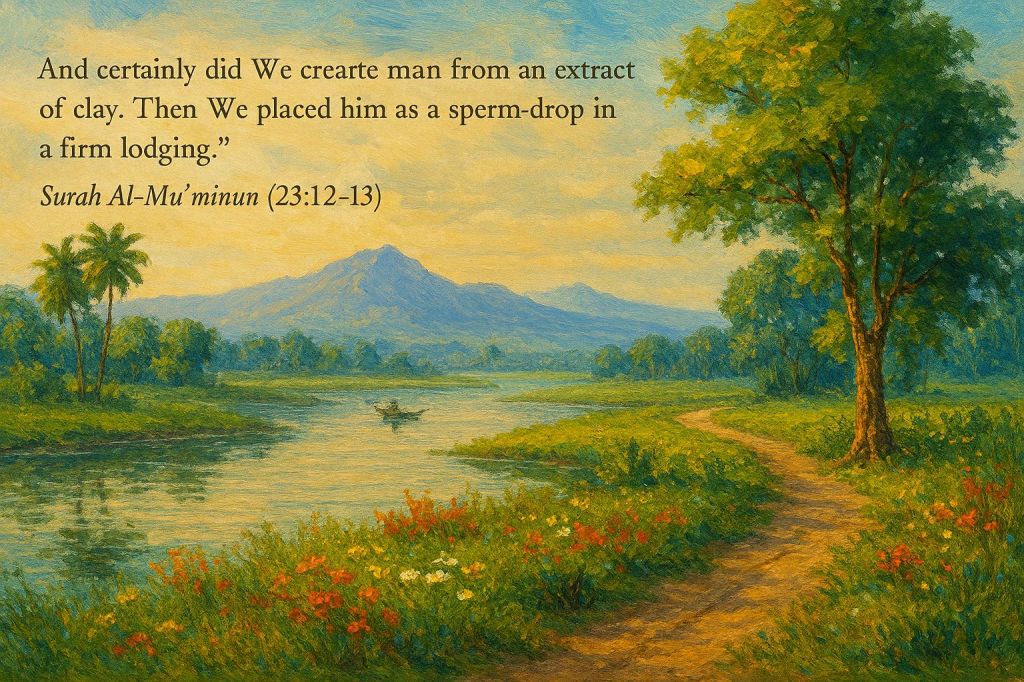
“And certainly did We create man from an extract of clay. Then We placed him as a sperm-drop in a firm lodging.”
(Surah Al-Mu’minun, 23:12–13)
These two simple verses, so often read and so easily passed over, hold within them the thunderous echo of humanity’s entire existential journey—from the silence of prehistory to the microscope of modern genetics. In just twenty words, the Holy Qur’an lifts the veil on the physical origin, spiritual destiny, and philosophical purpose of human life. And in the scholarly light of Hazrat Mirza Bashiruddin Mahmood Ahmad and the illuminating pen of Hazrat Mirza Tahir Ahmad, these verses burst forth with the radiance of guidance for both scientist and saint.
From Clay: The Elemental Contract
“Khalaqnā al-insāna min sulālatin min ṭīn” — “We created man from an extract of clay.”
This is not mythology. This is not allegory. This is divine precision.
The word “sulālah” (extract) signifies a refined selection, a distillation—not just ordinary mud, but a biological synthesis from the Earth’s essential elements. As Tafsir-e-Kabir so beautifully expounds, this phrase refers to the mineral matrix and organic compounds that make up the human body, borne of the same planetary womb from which all life springs.
Hazrat Mirza Bashiruddin Mahmood Ahmad (ra) writes:
> “It is not merely symbolic clay, but the very real constituents of the earth’s crust—calcium, iron, phosphorus, carbon—that flow through our veins and form the framework of our being.”
Modern science now confirms what these divinely revealed words foretold. From soil comes grain, from grain comes life. Every cell in your body, every strand of DNA, every beat of your heart—draws sustenance from elements that once lay buried in the silent stones of the Earth.
Yet, clay alone is not man. The next verse beckons us deeper.
Into the Lodging: The Divine Architecture of Embryology
“Thumma ja‘alnāhu nuṭfatan fī qarārin makīn” — “Then We placed him as a sperm-drop in a firm lodging.”
The Qur’an, over 1400 years ago, describes with eerie exactitude the journey of the sperm cell to the uterus, the “qarār makīn” — a firm, secure, protective abode.
The Five Volume Commentary remarks:
> “This description captures both the biological accuracy and the metaphorical majesty of God’s plan — that man is not the result of random process, but of measured design, secured in layers of divine protection.”
The sperm-drop — that nuṭfah, invisible to the naked eye — carries within it not just DNA, but destiny. In this infinitesimal droplet, the Qur’an identifies the dual nature of man: humble in origin, yet soaring in potential.
Modern genetics confirms this miracle. Within the nuṭfah lies a genetic code, a symphony of instructions that builds the human body — heart, mind, soul, capacity for thought, love, even faith. That which Darwin only guessed, and what Watson and Crick later unveiled in their double helix, the Qur’an declared centuries ago with divine clarity.
The Dual Nature: Between Dust and Divinity
Hazrat Mirza Tahir Ahmad (rh), in his deeply philosophical style, repeatedly emphasized that these verses do not merely speak of biology—they call us to reflection, to awakening, to accountability.
> “You are made of clay, and you carry the arrogance of angels? You came from a drop, yet you dream of eternity? Know yourself. Then know your God.”
This duality is central to the Qur’anic view of man: he is both earthly and spiritual, both fragile and exalted. He is ‘ashraf al-makhlūqāt’ (the noblest of creation) only when he transcends the clay and answers the call of the soul.
The Qur’an reminds man of his origin not to humiliate him, but to humble him — so that he might rise.
Rise from the Clay
These verses, when rightly understood, are not about biology—they are about becoming.
You were clay, yes. But you were chosen clay.
You were a drop—but within you is the breath of Divine Will.
In a world obsessed with origins and genetics, the Holy Qur’an reframes the question: Not where you came from, but what you were made for.
Hazrat Mirza Bashiruddin Mahmood Ahmad (ra) writes:
> “The beauty of this process is not merely in its science, but in its symbolism. From weakness to strength, from nothingness to nobility — the journey of every believer must mirror this creation.”
A Message for the Modern Soul
In an age of artificial intelligence, genome editing, and philosophical materialism, this verse rings like a trumpet blast: You are more than your matter.
So rise, O clay-born! Rise and remember:
You are not an accident.
You are a design.
You were placed — not fallen — into this world.
And you are destined — not doomed — to rise again.
Let the dust of your origin remind you of humility.
Let the spark in your soul awaken your divinity.
The Qur’an whispers from eternity:
“Certainly did We create man…”
Now it is your turn to become.
 Radio VOIB