–Saiful Islam
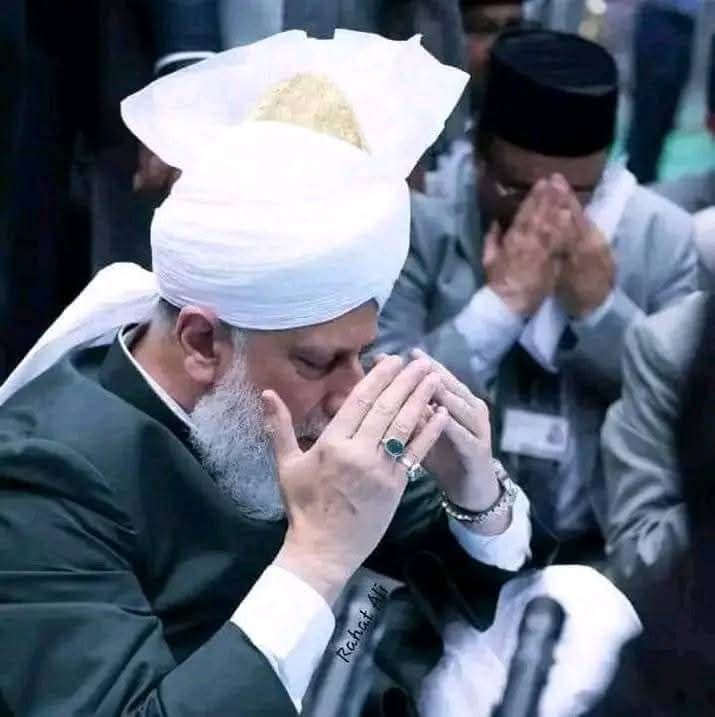
A Journey into the Soul’s Dialogue with the Divine
In the quiet folds of the night, when the world sleeps and the stars keep their solemn vigil, a human heart trembles—not from fear, but from yearning. It bends, it whispers, it weeps. This is prayer. But what is prayer, truly? Is it a soliloquy uttered into the void—or a dialogue with a Living, Listening, Responding God?
Hazrat Mirza Ghulam Ahmad (as), the Promised Messiah, declared:
“Prayer is not a dry ritual. It is a living connection with the Divine, a communion in which the soul speaks and God replies.”
Prayer: A Two-Way Communication
Hazrat Mirza Tahir Ahmad (rh) once observed, “Prayer is not one-directional. The heart speaks—and if one listens sincerely, the reply echoes back, not always in words, but in a transformation of the self, a whisper in the conscience, a light in the dark.”
Prayer, then, is both talking to God and listening to God. The Qur’an describes God as:
“He listens to the supplicant when he calls on Him.” (Surah Al-Baqarah, 2:187)
But also:
“When My servants ask thee concerning Me, tell them: I am near. I answer the prayer of the supplicant when he prays to Me.” (2:187)
This is not a passive nearness. This is interactive presence. To talk to God is human. But to listen for His reply—that is the start of transformation.
The Anthropology of Divine Dialogue
Anthropologically, prayer has existed in every society—primitive or modern. But what differs in Islam, and especially in Ahmadiyyat, is the certainty of God’s response. Every civilization prayed. Only a few claimed that the Invisible spoke back with clarity and power.
From Native American shamans to ancient Vedic seers, prayer was a channel—but often blurred by myth. In the Holy Qur’an, and further in the lives of Prophets—especially in the life of the Promised Messiah (as)—prayer became a scientifically observable reality.
As Hazrat Mirza Tahir Ahmad (rh) emphasized in his sermons, “Ahmadiyyat revives the lost glory of living contact with God—not metaphorical, but real. Measurable through transformation, confirmed by fulfilled revelation.”
The Psychology of Listening
Modern psychology confirms that active listening is the foundation of all successful relationships. If prayer is a relationship with God, then listening is as crucial as speaking.
Carl Rogers, the father of humanistic psychology, taught that “deep listening opens the soul.” Hazrat Mirza Bashiruddin Mahmood Ahmad (ra) echoed this in Tafsir-e-Kabir by explaining:
“Prayer in Islam is not just an appeal; it is an alignment. When a believer prays in humility, he opens himself to divine suggestion, to moral and spiritual reform.”
When we stop talking to God and start listening for God, we begin to change—not because we heard thunder—but because we felt peace, clarity, and resolve.
Sociological Impact of Listening in Prayer
Sociology teaches that belief in a responsive God affects human behaviour. A study published in the Journal for the Scientific Study of Religion found that people who believe God listens and responds are more ethical, community-oriented, and mentally stable.
Why? Because when prayer becomes a dialogue, it generates accountability. A man who thinks God hears him will think twice before sinning. But a man who knows God also replies—such a man becomes a servant, a warrior of peace, a reformer.
Hazrat Mirza Tahir Ahmad (rh) beautifully articulated this spiritual sociology when he said:
“Those who speak to God and listen to Him regularly cannot be corrupt. They carry His voice in their conscience.”
Scientific Echoes of Divine Reply
Is it possible that the human brain is wired for two-way communication with the Divine? Neuroscience suggests yes. Brain scans of devout Muslims in salat or dua show a heightened state of cortical synchronization—a unique harmony between the conscious and subconscious.
Could it be that prayer activates not only emotional centers but also intuitive ones? Could God’s reply come as insight, peace, a dream, a decision, or even a revelation?
Hazrat Mirza Ghulam Ahmad (as) proved this when he wrote:
“I have seen that when I weep before God, He replies—not always in voice, but always in result.”
The Ahmadiyya Experience: A Living Testimony
The community of the Promised Messiah (as) is not built on dead rituals. It is built on the bones and breath of prayer. From the Khalifa to the child, from the refugee to the scholar—every Ahmadi knows that prayer is the lifeline, not merely a practice.
How many times has the Jama’at been saved from disaster, guided in decision, inspired in innovation—through dua and its reply?
Hazrat Khalifatul Masih V (aba) often recounts incidents where members receive guidance in dreams, feel tranquillity in hardship, or find solutions against impossible odds—all through prayer. These are not hallucinations. These are divine conversations.
Prayer as Spiritual Symphony
So, is prayer talking to God or listening to God? It is both—and more. It is the fusion of longing and reply, the mirror where man sees God, and where God reforms man.
Hazrat Mirza Tahir Ahmad (rh) wrote:
“When prayer becomes deep, it becomes music. When it becomes music, it becomes revelation. And when it becomes revelation, it becomes revolution.”
Thus, true prayer is the start of all transformation. It is not a monologue, but a duet—between the dust of earth and the Majesty of Heaven.
Talk to God. But also—pause. Listen. For the Creator still speaks.
 Radio VOIB
Alhamdulillah
LikeLike