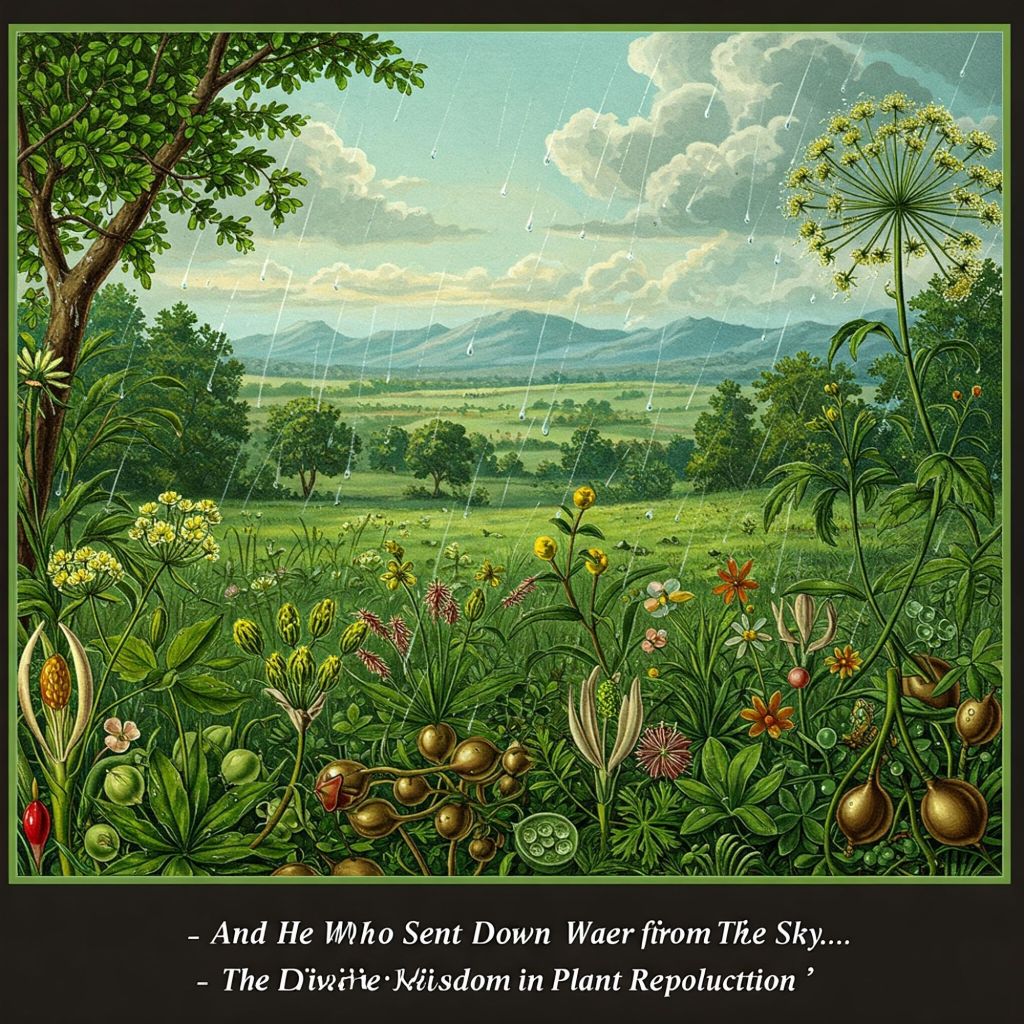
Inspired by Surah Ta-Ha (20:53)
In Surah Ta-Ha, Allah proclaims:
> “And He Who sent down water from the sky in due measure, and thereby caused pairs of plants to grow, each separate from the other.” (Surah Ta-Ha 20:53)
At first glance, this verse may appear to be simply a poetic depiction of rainfall and plant life. However, when examined through the enlightening perspectives of the Holy Qur’an, Tafsir-e-Kabir, and the advancements of science, it reveals a deep testament to Divine artistry in the science of plant reproduction. This field, while understood by humans mainly in its basic mechanics, hints at a greater intelligence at work.
The Journey of Water: “In Perfect Balance” — The Divine Art of Hydrology
Dive into the fascinating world of water dynamics, where every droplet tells a story. Explore how nature’s intricate design masters the art of balance in hydrology, showcasing the remarkable calibration that governs our planet’s most essential resource. Join us on this captivating adventure as we unveil the secrets of water’s descent, perfectly measured to sustain life on Earth.
Hazrat Mirza Bashiruddin Mahmood Ahmad (ra), in his Tafsir-e-Kabir, explains that the phrase “in due measure” pertains not just to the quantity of rain, but also to its precision. The term “mīqdār” implies a calculated proportion that is appropriate for the specific time, terrain, and temperature.
Modern hydrology confirms a remarkable order in nature: the water cycle is a finely balanced system. Rainfall patterns adjust to meet the geographical and ecological needs of various regions. If this system were to shift even slightly, deserts could flood while rainforests might perish. This is not a random occurrence; it is the deliberate design of a higher power.
Discovering the Quran’s Profound Wisdom on Sexual Reproduction in Nature: The Remarkable Concept of Plants in Pairs.
The Qur’an highlights the concept of “azwāj,” or pairs, as a fundamental aspect of creation. Notably, it applies this idea to plants, indicating that they are also governed by the principles of pairing—specifically, male and female roles. This understanding of sexual differentiation in plants predates Western science’s discovery of this concept.
Hazrat Khalifatul Masih II (ra) emphasized in Tafsir-e-Kabir that the pairing in plants includes not only visible gendered structures but also more subtle forms such as pollination, hybridization, and genetic divergence. In fact, the Qur’an, revealed 1,400 years ago, alluded to concepts like cross-pollination and biodiversity long before the terms introduced by Mendel or Linnaeus were known.
“Each Separate From the Other” — Genetic and Reproductive Isolation
The verse concludes with a profound scientific statement: “Each separate from the other.” Hazrat Mirza Bashiruddin Mahmood Ahmad (ra) explains that this refers to the variation among plant species and their inability to merge into a single reproductive system. This prophetic insight aligns with what biology now describes as reproductive isolation — the mechanism through which species preserve their uniqueness and prevent genetic collapse.
This separation is not chaos but a Divine orchestration. It allows biodiversity to thrive, keeps ecosystems stable, and helps crops evolve with resilience. God has not only created species — He has also safeguarded their sacred boundaries.
The Pollination Parable: A Spiritual Reflection
Hazrat Mirza Tahir Ahmad (rh) often reflected on how nature serves as a mirror of spiritual truths. The process of pollination, with its delicate reliance on wind, insects, and timing, is not merely a biological function — it is a parable.
A flower cannot bear fruit unless its pollen is carried, often from a distance, and sometimes by unseen forces. In the same way, the human soul cannot fully flourish until it is touched by revelation, the spiritual winds of truth, or a messenger sent at the right time.
As the bee unknowingly serves life by transferring pollen, the righteous servants of God carry divine influence, triggering transformation in others.
“Revelation and Rainfall: The Shared Descent from Above”
In the Qur’an, water is frequently used as a metaphor for revelation.
> “And We sent down from the sky water full of blessings…” (Surah Qaf 50:9)
Hazrat Mirza Tahir Ahmad (rh) illustrated beautifully how revelation and rainfall are similar: both descend from above and give life to what is lifeless—rain giving life to the earth and revelation nourishing the soul. In the verse from Surah Ta-Ha, rain nourishes the land, just as prophetic guidance nurtures civilization.
The arrival of prophets, like the onset of spring rain, awakens dormant potential. Just as plants need sunlight, pollinators, and the right timing, human hearts similarly require light, love, and guidance.
Cultivating a Compassionate Heart for Growth and Connection
The botanical metaphors in the Qur’an are not just for botanists. They represent a divine language, filled not only with cellular knowledge but also with spiritual wisdom. When Allah refers to “pairs of plants,” He invites us to observe His planning, precision, and provision—both in nature and in guidance. This connection exists in leaves and laws, in chloroplasts and commands.
Let us not pass by the next flowering tree casually. Within its delicate flowers lies a message: You, too, were designed to bloom — if you allow truth to nourish your heart.
 Radio VOIB