— A Sacred Reflection on QV66 in the Light of Eternal Truths
✍️ By VOIB Radio Editorial Desk | In the spirit of Hazrat Mirza Tahir Ahmad (rh)
“Death is not the end of life—it is the veil behind which eternity begins.”
— Hazrat Mirza Tahir Ahmad (rh)
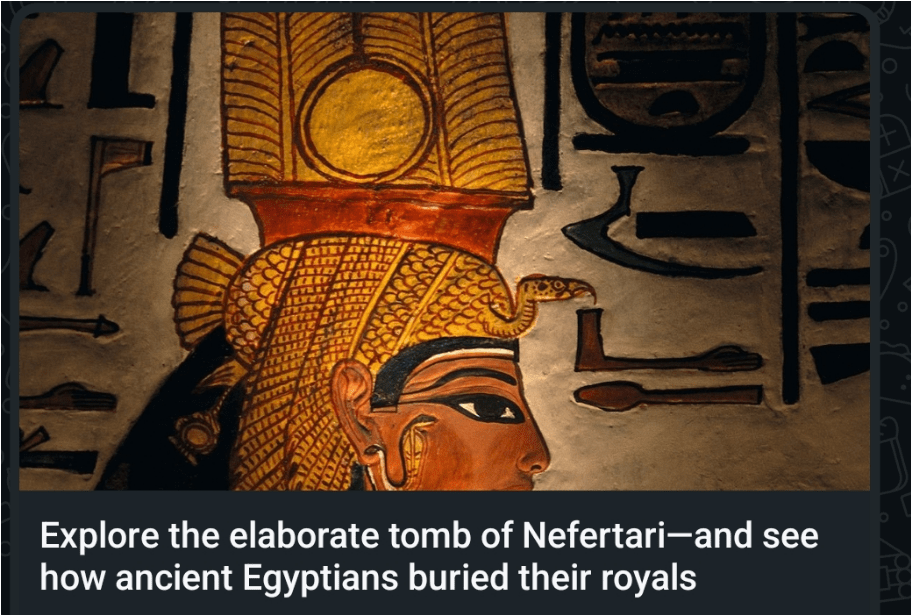
In the desolate embrace of Egypt’s Valley of the Queens lies a silent wonder, carved not merely into stone—but into the spiritual consciousness of a civilization that dared to dream beyond death. The tomb of Queen Nefertari, wife of the great Ramses II, is more than an archaeological marvel. It is a map of the soul’s journey, an artistic scripture inscribed in colour, myth, and divine longing.
Discovered in 1904 by Italian Egyptologist Ernesto Schiaparelli, tomb QV66 has since been hailed as the Sistine Chapel of Ancient Egypt, not only for its dazzling artistry but for the sacred story it tells—a story of departure, passage, judgment, and rebirth.
🕯️ A Tomb Transcending Time
At first glance, Nefertari’s tomb appears to be a royal burial chamber. But upon reflection, it reveals itself as something far greater: a divine theatre, where the queen rehearses her resurrection before an audience of gods. The walls, adorned with verses from the Book of the Dead, narrate her perilous journey through the underworld and her eventual emergence into eternal life—transfigured and exalted.
Each symbol, each hue, is deliberate. Nothing is ornamental. The tomb is not a monument to death, but a celebration of life renewed.
👁️ Guardians of the Afterlife: Divine Companions on the Journey
Throughout QV66, Queen Nefertari is portrayed standing before the gods—Thoth, the scribe of destiny; Osiris, the lord of resurrection; Ptah, the architect of the cosmos; and Ma’at, the embodiment of truth and balance. They offer her sacred gifts: wisdom, purity, protection, and harmony. She is not alone. She is guided, welcomed, and prepared for a realm beyond comprehension.
Even the ceilings of the tomb are painted with deep blue skies, sparkling with stars—suggesting that the queen has transcended the earthly plane and now sails among the divine constellations.
🧭 The Axis of Afterlife: From Darkness to Dawn
Scholars have long noted a sacred geography within the tomb. One axis moves westward—symbolizing the descent into the realm of Osiris, where the soul is judged. The other moves eastward—towards the soul’s rebirth in the light of Ra, the sun god. This sacred orientation mirrors the daily journey of the sun itself: dying in the west, reborn in the east.
In this way, Nefertari’s tomb is not just a resting place—it is a cosmic compass, directing her soul from the decay of mortality to the brilliance of divine eternity.
🎨 A Canvas of Eternity: The Art of the Divine
The artistry of QV66 remains unsurpassed. Spanning over 520 square meters, with nearly 3,000 square feet of original paintings still preserved, the tomb radiates vitality and awe. Red ochres, golden yellows, deep blues, and emerald greens create a visual symphony that has defied time and decay.
The queen is depicted with regal dignity: almond-shaped eyes, gracefully arched brows, flowing garments, and even silver earrings—an unusual detail that hints at international influence and her elevated status.
And yet, notably absent from these sacred scenes is her husband, Ramses II. This absence is striking. It suggests that in the afterlife, the soul travels alone. No titles, no spouse, no kingdom. Only one’s deeds and devotion accompany the soul into eternity.
🛡️ Truth, Order, and Divine Guardianship
The tomb is protected by divine beings—Ma’at, Wadjet, and Nekhbet—guardians of truth, justice, and life’s sacred order. Their presence is no coincidence. In the ancient Egyptian worldview, the soul could not proceed into the afterlife unless it had lived a life by Ma’at, the cosmic law.
This resonates deeply with the teachings of all divinely revealed religions: that spiritual accountability is inseparable from our journey beyond death.
🌟 Echoes of Eternity: A Message for Every Age
The story of Nefertari’s tomb is not bound to the Nile, nor confined to the past. It reverberates through every human heart that has ever pondered the mystery of death.
In the writings of Hazrat Mirza Tahir Ahmad (rh), one finds a similar spiritual blueprint:
“Life does not end with the closing of the eyes. The soul, having shed its earthly cloak, begins a journey of purification, ascent, and union with the Divine.”
Just as Nefertari’s painted walls speak of transformation through divine proximity, so too does the Qur’an speak of the righteous being brought near to God in gardens of bliss (Surah al-Waqi’ah, 56:11-12).
🔍 Summary of Spiritual Insights and Historical Truths
Element Details
Location Tomb QV66, Valley of the Queens, Luxor
Discovery 1904 by Ernesto Schiaparelli
Queen Nefertari Chief consort of Ramses II, c. 13th century BCE
Religious Texts Depicted Book of the Dead, Judgment before Osiris
Divine Symbols Thoth, Osiris, Ptah, Ma’at, Wadjet, Nekhbet
Spiritual Architecture Western descent into underworld; Eastern rebirth with Ra
Artistic Significance One of the most beautiful and best-preserved tombs; “Sistine Chapel of Ancient Egypt”
Spiritual Parallel Life after death; soul’s accountability; divine justice and mercy
🕊️ A Tomb That Teaches
QV66 is not merely a crypt of stone—it is a classroom of the soul. It whispers through its hieroglyphs and paintings: Prepare. Reflect. Awaken. Death, in this sacred theology, is not annihilation—but transition. The tomb becomes a doorway, and the queen—a traveller in search of the light.
So too should we live—with consciousness of our end and hope in a divine beginning.
As Hazrat Mirza Tahir Ahmad (rh) often reminded:
“This life is a test, a field of sowing. The harvest comes in the Hereafter. Sow love, truth, and God’s remembrance—and reap eternal light.”
📸 Explore More:
National Geographic – Inside Queen Nefertari’s Tomb
Wikipedia: Tomb of Nefertari (QV66)
Egypt Museum: Wall Paintings of Nefertari
 Radio VOIB