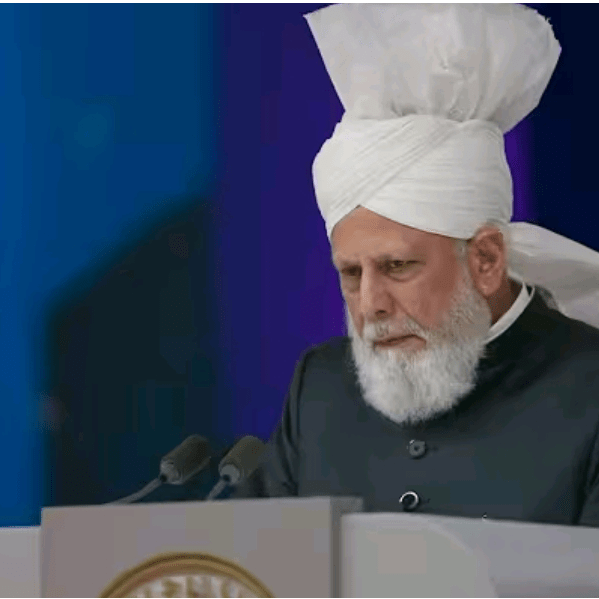
A Beacon of Peace in a Restless World
Five Life-Changing Lessons from the Closing Address of Jalsa Salana UK 2026
Introduction: A Light for an Unsettled Age
Humanity is walking through one of the most remarkable—and paradoxical—eras in history.
Our cities are brighter than ever, yet our hearts often feel darker. Technology has empowered our hands, but it has not quieted our souls. Material comforts have multiplied, yet genuine inner peace seems increasingly elusive. The more connected we become digitally, the more disconnected we often become from ourselves—and from our Creator.
It was against this backdrop that the Closing Address of Jalsa Salana UK 2026, delivered by His Holiness Hazrat Mirza Masroor Ahmad (aba), the Fifth Khalifa of the Ahmadiyya Muslim Community, emerged as far more than a religious discourse. It was a profound diagnosis of the spiritual crisis confronting modern humanity—and a timeless prescription for healing.
More than 51,181 participants representing 117 countries attended the convention in person, while millions more joined through MTA International, with broadcasts reaching 95 centres across 62 countries. Yet the significance of this address cannot be measured by attendance figures alone. Its true impact lies in its ability to awaken hearts and inspire a return to God.
1. The Hidden Form of Shirk: Have We Begun to Forget Allah Without Realizing It?
When the word shirk is mentioned, many immediately think of idol worship. Yet His Holiness drew attention to a far subtler—and perhaps more dangerous—form of associating partners with Allah.
Today, many people place their ultimate trust in careers, wealth, influence, or powerful connections. These are blessings and necessary means of life. However, when dependence on these worldly means surpasses reliance upon Allah, the seeds of hidden shirk begin to grow.
His Holiness illustrated this profound truth with a simple example. Many relationships are built upon temporary interests—a favour, a benefit, or a shared convenience. When the benefit disappears, so does the relationship.
But relationships founded for the sake of Allah endure every storm.
The greatest tragedy is not always openly denying God. More often, it is gradually forgetting Him.
2. Truthfulness: The Greatest Jihad of Our Time
We live in an age where deception is frequently celebrated as cleverness, while honesty is dismissed as weakness.
His Holiness reminded us that the true strength of a believer is measured not by intelligence, status, or influence—but by unwavering truthfulness.
Whenever someone conceals the truth to protect personal interests, reputation, social standing, or public image, they reveal that they fear people more than they fear Allah. That misplaced fear is itself a subtle form of spiritual decline.
Referring to the historic Post Office case involving the Promised Messiah (as), His Holiness demonstrated that truth may leave a person standing alone at first—but ultimately, it leads to honour, vindication, and lasting victory.
Truthfulness is not merely a moral virtue.
It is the spiritual backbone of a believer.
3. Purity of the Gaze: The Silent Beauty of True Civilization
Modern culture often presents immodesty as freedom and self-restraint as outdated.
Yet true civilization has never been built upon unrestrained desires.
It begins with disciplined character.
His Holiness reminded us that lowering one’s gaze (ghadd-e-basar) is not a command exclusively for women. It is an equally essential responsibility for men, because the eyes are the gateway to the heart.
He outlined practical steps for protecting one’s spiritual purity:
– Guard your eyes from unlawful glances.
– Avoid conversations and tones that encourage inappropriate attraction.
– Stay away from immoral literature, entertainment, and media.
– Distance yourself from environments where temptation is strong.
– Strengthen self-control through voluntary fasting, particularly during youth.
When the eyes are disciplined, the heart gradually becomes purified.
4. Love for Humanity: Forgiveness Is the Strongest Form of Strength
A person may spend countless hours in worship.
But worship loses its beauty if compassion for others is absent.
His Holiness emphasized that believers should never become seekers of people’s faults, carriers of gossip, or prisoners of revenge.
Referring to the case of Dr. Clark, he highlighted how the Promised Messiah (as), despite having every legal opportunity to pursue retaliation against those who conspired against him, instead chose forgiveness, mercy, and magnanimity.
That choice transformed an ordinary legal victory into an extraordinary moral triumph.
Forgiveness is not weakness.
It is the strength of a heart filled with the love of Allah.
In today’s divided and conflict-ridden world, this lesson may be more relevant than ever before.
5. Tahajjud and Istighfar: The Keys to Spiritual Renewal
When hardship strikes, people instinctively knock on countless worldly doors.
Yet the greatest door has never been closed.
The door of Allah remains open at every moment.
His Holiness placed special emphasis on Tahajjud, voluntary worship, and Istighfar.
He explained that seeking forgiveness is not merely asking Allah to erase yesterday’s mistakes.
It is also asking Him to grant the spiritual strength needed to overcome tomorrow’s challenges.
Istighfar carries two extraordinary blessings:
It protects believers from the harmful consequences of past mistakes while equipping them with the strength to resist future sins.
A heart that sincerely turns back to Allah never remains a prisoner of despair.
Conclusion: Real Change Begins Within
The Closing Address of Jalsa Salana UK 2026 was far more than a sermon.
It was a blueprint for spiritual renewal, moral excellence, and lasting human transformation.
Its central message was beautifully simple:
If we wish to change the world, we must first transform ourselves.
A faith free from hidden shirk…
An unwavering commitment to truth…
A disciplined gaze…
A forgiving heart…
And an intimate relationship with Allah…
These are the qualities that elevate ordinary people into extraordinary servants of God.
Perhaps we cannot calm every storm that rages across the world.
But every one of us can kindle a lamp of peace within our own hearts.
History repeatedly reminds us of one timeless truth:
The transformation of an age often begins with the illumination of a single soul.


It shows the Allmighty God is with this Jamaat which is giving them great success
Alhamdulilah
LikeLike