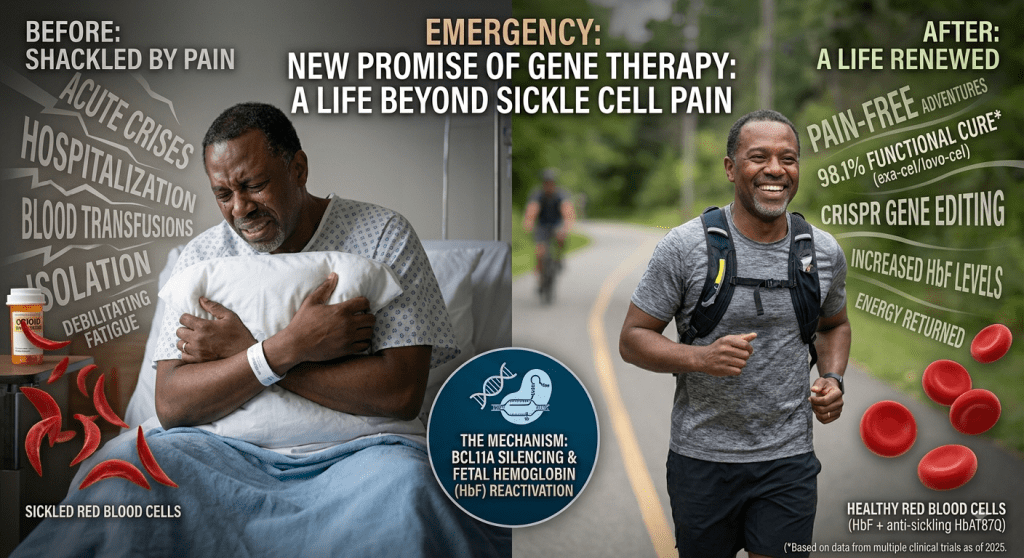
A revolutionary treatment can alter the blood at the source of the disease. The harder question is whether medicine can make such a costly and demanding therapy widely available.
By Saiful Islam
The question sounds almost too ordinary to be remarkable.
When can I go back to school?
For a child with sickle cell disease, it can be a difficult question to answer.
However, it always requires another hospital visit first. Another night of pain. Another cancelled game. Another morning when getting out of bed requires more courage than a child should need.
Sickle cell disease has a way of shrinking the horizon of everyday life. A birthday is planned around the possibility of a crisis. A family vacation requires medication and contingency plans. A child’s parents learn the geography of emergency departments.
The disease is written into the blood.
Now scientists are trying to rewrite it.
Gene therapy has moved from the realm of experimental medicine into clinical practice, offering some patients with severe sickle cell disease the possibility of going years without the debilitating pain crises that have shaped their lives.
The achievement is extraordinary.
However, it raises an uncomfortable question.
What happens when medicine discovers how to change a disease before society has figured out how to make that treatment accessible?
A disease measured in pain
Sickle cell disease is caused by an inherited mutation that affects hemoglobin, the protein responsible for carrying oxygen throughout the body.
The mutation can cause red blood cells to become rigid and crescent-shaped. Instead of passing freely through the smallest blood vessels, the cells can obstruct circulation, producing episodes known as vaso-occlusive crises.
The pain can be severe.
Repeated crises can damage organs and tissues and contribute to long-term disability and premature death.
For decades, medicine has had ways to manage the disease. But management is not the same as removing the underlying problem.
Patients and families have learned to live with uncertainty.
Will the pain return tonight?
Will this headache become something worse?
Will another hospital admission mean missing another week of school?
For many, the disease becomes a calendar of interruptions.
Gene therapy offers something different.
Not merely another way to control the symptoms, but an attempt to change the cells that produce the blood.
Editing the instructions
The science behind the treatment is complicated.
The idea is surprisingly simple.
Doctors collect blood-forming stem cells from a patient’s own body. In a laboratory, scientists alter those cells genetically. The modified cells are then returned to the patient, where they can establish themselves in the bone marrow and produce new blood cells.
Casgevy, approved by the U.S. Food and Drug Administration in 2023, uses CRISPR/Cas9 gene-editing technology. It is the first FDA-approved treatment to use this form of genome editing.
The treatment does not simply erase the mutation responsible for sickle cell disease.
Instead, Casgevy is designed to increase production of fetal hemoglobin, a form of hemoglobin that can help prevent red blood cells from sickling.
The patient’s own cells become the starting material for the treatment.
Something is striking about that.
The medicine does not arrive in a bottle.
It begins with the patient.
The number that changed the conversation
In the clinical trial supporting Casgevy’s approval, 44 patients with sickle cell disease received the treatment. Among the 31 patients who had enough follow-up time to be evaluated for the primary efficacy outcome, 29—93.5 percent—experienced no severe vaso-occlusive crises for at least 12 consecutive months.
For researchers, the figure is compelling.
For families, the meaning is more immediate.
A year without a severe pain crisis can mean a year without repeated emergency room visits.
It can mean fewer nights spent beside a hospital bed.
It can mean school attendance.
Work.
Travel.
Sleep.
The things that rarely appear in clinical trial tables.
The things that make up a life.
The youngest patients are entering the picture
The potential reach of the treatment expanded again this year.
On July 1, 2026, the FDA approved Casgevy for patients as young as 2 years old with sickle cell disease and recurrent vaso-occlusive crises. It was the first gene therapy approved by the agency for children that young with sickle cell disease.
The change carries an unusual emotional weight.
A two-year-old cannot understand what a genetic disease is.
The child does not know what CRISPR means.
There is no way to explain the significance of a modified stem cell.
But a child understands pain.
And a child understands play.
For parents, the promise is not necessarily scientific.
It is practical.
Perhaps the child will miss fewer days of school.
Perhaps there will be fewer trips to the hospital.
Perhaps childhood can become less about anticipating the next crisis and more about discovering what comes next.
The price of a second chance
But the treatment has another number attached to it.
Millions of dollars.
The Congressional Budget Office noted that the two gene therapies approved for sickle cell disease each have list prices above $2 million. The therapies are administered as one-time treatments, but the treatment process is lengthy and carries significant medical risks.
The price tag, however, tells only part of the story.
The therapy requires a complicated sequence of medical procedures.
Stem cells must be collected.
They must be modified.
The patient’s bone marrow must be prepared, including high-dose chemotherapy.
The edited cells must then be infused back into the patient.
And the patient must remain under close medical supervision.
The European Medicines Agency describes Casgevy as an individualized treatment made from the patient’s own stem cells and administered in specialized centres by teams experienced in stem-cell transplantation and blood disorders.
This is not a treatment that can simply be prescribed and picked up at a neighbourhood pharmacy.
It requires an entire medical ecosystem.
The geography of a breakthrough
That creates a problem familiar across modern medicine.
A scientific breakthrough can be global in significance while remaining geographically limited in practice.
The patient needs to reach a specialized centre.
The centre needs trained staff.
The laboratory needs sophisticated equipment.
The healthcare system needs to pay.
And the patient needs to be healthy enough—and medically eligible enough—to undergo an arduous treatment process.
For a family living near a major medical centre, these may be difficult obstacles.
For a family living hundreds or thousands of kilometres away, they can become something else entirely.
A wall.
The irony is difficult to ignore.
Human beings have developed technology capable of editing DNA at a molecular level.
Yet access to that technology can still depend on something much older:
where a person lives and what a healthcare system can afford.
A cure is not the same as access
There is another reason for caution.
Gene therapy is new.
The early results are encouraging, but researchers continue to follow patients over the long term to understand the durability of the benefits and the potential risks.
The FDA requires long-term follow-up for patients treated with Casgevy and Lyfgenia.
That is not a criticism of the science.
It is the nature of science.
A breakthrough does not end a question.
It creates better questions.
How long will the benefit last?
Which patients will benefit most?
What will the treatment mean decades from now?
Can manufacturing become cheaper?
Can hospitals deliver it more efficiently?
And perhaps the most important question:
Can a therapy designed for extraordinary circumstances eventually become available to ordinary families?
The meaning of an ordinary day
Medicine often speaks in the language of measurable outcomes.
A crisis avoided.
A blood count improved.
A hospitalization prevented.
A survival curve extended.
All of these matter.
But families experience success differently.
A child wakes up on Monday morning.
He gets dressed.
He eats breakfast.
He puts on his shoes.
His mother asks:
“Are you feeling all right?”
“Yes.”
Then he leaves for school.
There is no headline in that moment.
No laboratory report.
No dramatic announcement.
Just an ordinary morning.
For a family accustomed to living around sickle cell disease, that ordinary morning may be extraordinary.
The future may belong to ordinary miracles
The first generation of gene therapies has arrived with a strange combination of brilliance and difficulty.
The science is remarkable.
The treatment is demanding.
The price is enormous.
The infrastructure is limited.
And the long-term story is still being written.
Yet medical history suggests that today’s extraordinary procedures can become tomorrow’s ordinary treatments.
Technologies become more efficient.
Manufacturing improves.
Costs fall.
Medical expertise spreads.
Health systems adapt.
That process will determine whether gene therapy remains a treatment available to a relatively small number of patients or becomes a broader answer to one of the most painful inherited blood disorders known to medicine.
The scientific challenge was to change the cell.
The social challenge is to change the system around it.
And then, a field
Imagine the same child years from now.
It is late afternoon.
There is a football on the grass.
Friends are shouting.
His mother is watching from the edge of the field.
“Slow down,” she calls.
He does not.
He runs faster.
Then he turns and looks back.
“Mom, watch this!”
She watches.
Perhaps that is what a medical breakthrough ultimately looks like.
Not a laboratory.
Not a microscope.
Not a gene being edited.
A child running across a field without thinking about whether his body will betrayyyyyyy him.
A mother watching without wondering when the next crisis will come.
A family making plans without first asking where the nearest hospital is.
That is the promise contained within the science.
Not simply longer life.
Not simply fewer hospital visits.
Something quieter.
Something harder to measure.
The possibility of an ordinary life.
Gene therapy has opened the door.
The next task is to make sure that door does not remain open only for the fortunate.
Because the most meaningful measure of a medical revolution will not be how extraordinary the science is.
It will be how ordinary the life becomes for the people it was meant to help.

