Troy: The City That Refused to Disappear
By Saiful Islam
There are places where history feels less like the past than a presence.
Troy is one of them.
On a low, windswept mound at Hisarlık in northwestern Türkiye, there are no soaring palaces, no intact royal chambers, no grand avenue announcing that this was once the city that inspired one of the greatest stories ever told.
There are stones.
Walls.
Foundations.
Fragments of lives that ended thousands of years ago.
And yet, stand among them long enough, and the imagination begins to fill the silence.
A city rises.
Ships gather somewhere beyond the plain. Traders cross crowded streets. Guards watch the horizon. Behind fortified walls, families store grain and water. Somewhere in the distance, a poet is turning the memory of a vanished world into legend.
This is the strange power of Troy: the ruins are real even when the story remains uncertain.
For more than four millennia, people built, abandoned, rebuilt and transformed this settlement. Archaeologists now recognize a succession of major occupation phases at Hisarlık, from Troy 0 through Troy IX, preserving a remarkably long record of human settlement. The earliest known occupation reaches back to about 3600 B.C.
Homer gave the city its immortality.
Archaeology gave it a history.
Where the sea once came to Troy
Troy’s location was not an accident.
The settlement stood near the southern entrance to the Dardanelles, the ancient Hellespont—a strategic corridor between the Aegean and Black seas. In the Bronze Age, the coast lay much closer to Hisarlık than it does today, placing the settlement near important maritime routes.
Troy was therefore more than a setting for an epic.
It was a crossroads.
Ships passed through the region. Goods moved between Anatolia, the Aegean and lands farther east and west. The city occupied a position where geography could become wealth—and where wealth could become vulnerability.
But landscapes change.
Over centuries, sediment carried by the Karamenderes River gradually filled the ancient bay. The shoreline retreated roughly five kilometers westward. Troy became increasingly separated from the sea and more dependent on agriculture, pastoralism and overland trade.
It is one of the quieter ironies of Troy.
The city that once watched the sea eventually found the sea moving away.
The Troy Homer never knew
The Troy of the Iliad is a city of heroes.
Achilles.
Hector.
Helen.
Priam.
The wooden horse.
Archaeology speaks a different language.
It does not find Achilles’ sword or Priam’s throne. It finds walls, pottery, storage jars, weapons, burned layers and collapsed buildings. It asks when they were built, how they were used and why they disappeared.
Two Bronze Age phases have become especially important in the search for Homer’s world: Troy VI and Troy VIIa.
Troy VI, flourishing roughly between 1750 and 1300 B.C., was a substantial fortified settlement. Its massive limestone walls and large elite buildings reveal sophisticated construction, while imported Mycenaean, Cypriot and Egyptian pottery points to extensive connections beyond Anatolia.
The city appears to have ended not in Homeric flames, but in an earthquake.
Around 1300 B.C., Troy VI suffered a catastrophic destruction marked by collapsed masonry and structural damage without the clear archaeological signature of a military assault.
But the story did not end.
The survivors rebuilt.
A city preparing for war
Troy VIIa was different.
Its inhabitants altered the old city to meet a more uncertain world. Large houses were divided into smaller living spaces. Huge ceramic storage jars—some approaching two meters in height—were sunk into floors, creating reserves of food and supplies. The changes suggest a population living under pressure, perhaps anticipating scarcity or prolonged insecurity.
Then, around 1180 B.C., the city burned.
This time the evidence is far more violent.
Archaeologists found thick layers of ash and charcoal, human remains showing lethal trauma, stockpiles of sling stones and bronze arrowheads.
Was this the Trojan War?
No archaeologist can answer that with certainty.
But the possibility is difficult to ignore.
The destruction of Troy VIIa falls within the broad period traditionally associated with the upheavals remembered in the stories of the Trojan War. It is not proof of Homer’s narrative. It is something more subtle: a physical record of a real Bronze Age city destroyed amid an era of violence that may have contributed to the memories later transformed into epic.
The distinction matters.
Troy is powerful precisely because archaeology does not need to turn uncertainty into certainty.
The treasure that fooled its discoverer
The modern search for Troy has its own epic qualities.
In the 19th century, many scholars doubted that Homer’s city could be located at all. Charles Maclaren proposed Hisarlık in 1822. Frank Calvert later excavated part of the mound. Then came Heinrich Schliemann, the wealthy German businessman whose determination—and impatience—would transform the archaeology of Troy.
Schliemann believed he was looking for the world of Priam.
He excavated aggressively, cutting a deep trench through the mound in his effort to reach what he considered the oldest and most important remains. In 1873, he uncovered an extraordinary collection of gold ornaments, silver vessels and bronze objects.
He called it “Priam’s Treasure.”
The name was wrong.
The treasure belonged to Troy II, a settlement that existed nearly a thousand years before the probable period of the Trojan War.
It was one of archaeology’s great lessons in humility.
Schliemann had found something spectacular.
He had simply found it in the wrong Troy.
The city beneath the city
That mistake opened the door to a more complicated truth.
Troy was not one city.
It was many.
Troy II was followed by Troy III, IV and V. Troy VI rose later as a powerful fortified center. Troy VIIa rebuilt itself after disaster and then met another violent end. Later still came Greek Ilion and Roman Ilium.
The mound became a kind of vertical history book.
To look at Troy is therefore to look not only backward but downward.
Every layer tells a different story.
The lower stones belong to people whose names have been forgotten. Above them are the remains of others who rebuilt on the same ground. Centuries later, Greeks returned and made the site sacred. Romans transformed it again, building theaters, public spaces and monuments around a city whose legendary past had become part of its political identity.
The remarkable thing is not that Troy survived.
It is that people kept coming back to it.
The horse is only the beginning
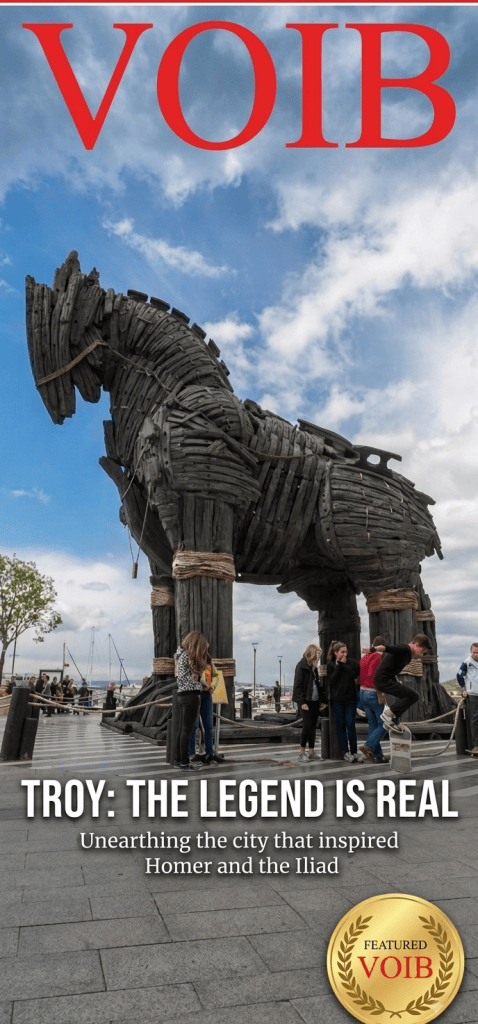
Today, visitors arrive at Troy through an entrance dominated by a reconstructed wooden horse.
It is impossible to resist.
People photograph it. Children climb inside. Adults smile at the absurdity of standing beside an object that represents one of history’s most famous deceptions.
But the horse is only the beginning.
A wooden boardwalk leads visitors through the archaeological remains. Along the route are the great fortification walls of Troy VI, the foundations of ancient buildings and the remains of later Greek and Roman structures.
The Pithos Garden offers another glimpse into ordinary life, displaying enormous storage vessels associated with the Bronze Age settlement. These are not glamorous objects.
That is precisely why they matter.
Empires are remembered through monuments.
Cities are understood through storage jars.
A pithos tells us that someone needed to preserve food. Someone expected tomorrow to arrive. Someone was planning for winter, famine or perhaps war.
History becomes intimate when you look closely enough.
Inside the Troy Museum
Nearby, the Troy Museum carries the story beyond the ruins.
Opened in 2018, the museum’s rust-colored exterior was designed to resemble an archaeological object emerging from the Anatolian landscape. Inside, the galleries move chronologically through the history of Troy and the wider Troad.
Bronze Age weapons and ornaments sit alongside pottery and other objects of daily life. Exhibits explore the relationship between archaeological evidence and the Homeric tradition, while later galleries trace the history of Greek Ilion and Roman Ilium.
Among the museum’s notable objects is the Polyxena Sarcophagus, a late-sixth-century-B.C. marble monument whose reliefs depict the sacrifice of Polyxena, a figure from the Trojan tradition.
The museum quietly makes an important point:
Troy did not belong only to the Bronze Age.
Every generation that encountered the site created its own Troy.
What survives when everything else is gone?
Perhaps that is the question Troy ultimately poses.
Not whether Achilles really stood on these walls.
Not whether Helen’s face launched a thousand ships.
Not even whether a wooden horse entered the city.
The deeper question is what allows a place to survive after the people who built it have vanished.
At Hisarlık, the answer is layered.
Stone survives.
Pottery survives.
Ash survives.
A buried storage jar survives.
A wall survives.
And then, somehow, a story survives.
The archaeological record shows Troy as a resilient settlement shaped by trade, environmental change, political upheaval, earthquakes and warfare. The destruction of Troy VIIa provides striking evidence of violence, while the monumental architecture of Troy VI reflects the wealth and regional importance of the Late Bronze Age settlement.
But archaeology also teaches restraint.
We may never know exactly how much of Homer’s Troy came from historical memory and how much from poetic invention.
Perhaps that uncertainty is part of the magic.
Because Troy does not need to prove every line of Homer to be extraordinary.
It only needs to remind us that behind the myths were real people, living in a real city, facing the same ancient uncertainties that still follow us:
Will there be enough food?
Will the walls hold?
Will the city survive?
Will anyone remember us?
Thousands of years later, someone still does.
That is Troy’s final victory.
The walls fell.
The kingdoms disappeared.
The shoreline moved.
The heroes became stories.
But the city remained beneath the earth, waiting patiently to be found.
And when we finally find it, we discover something unexpected:
Troy was never simply the city that inspired a legend.
Troy is the legend of what happens when a city refuses to be forgotten.

