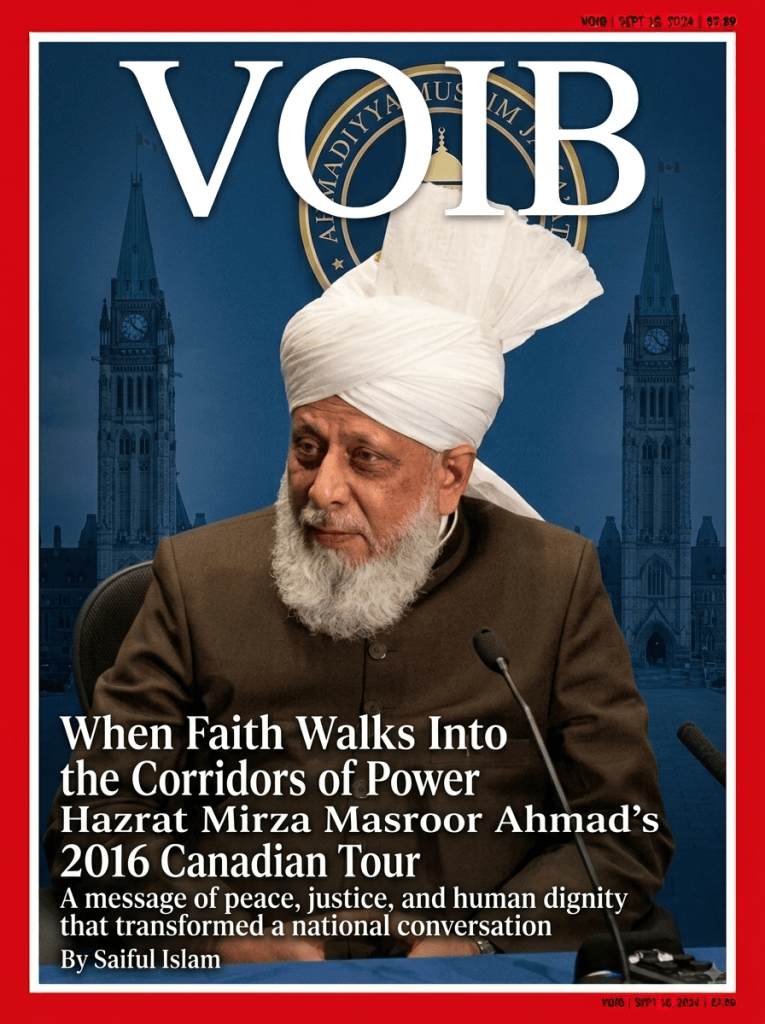
How Hazrat Mirza Masroor Ahmad’s 2016 Canadian tour transformed a message of peace, justice and human dignity into a national conversation
By Saiful Islam
There are moments when a religious leader enters a parliament and the room seems to become larger.
Not because a bill is about to be passed. Not because an election is being decided. But because the conversation suddenly rises above the ordinary business of politics—to questions of conscience, justice, human dignity and the fragile future of humanity.
On October 17, 2016, Hazrat Mirza Masroor Ahmad, Khalifatul Masih V and spiritual head of the Ahmadiyya Muslim Community, arrived at Canada’s Parliament Hill in Ottawa.
He met privately with Prime Minister Justin Trudeau and held discussions with senior ministers, senators and members of Parliament. Later, during Question Period, he was formally introduced in the House of Commons. Members from across the political spectrum rose in applause.
Yet the applause was not the story.
The story was what he asked his audience to confront after the applause had faded.
That evening, more than 225 people gathered at the Sir John A. Macdonald Building. Among them were more than 50 parliamentarians, cabinet ministers, diplomats representing 11 countries, academics and civil-society leaders.
Before them stood a religious leader carrying a message with a deceptively simple title:
“Human Values—the Foundation for a Peaceful World.”
Its implications were anything but simple.
At the heart of the address was a question that has become even more urgent with time:
What happens when a world connected by technology becomes disconnected by conscience?
The paradox of a connected world
Modern civilization has conquered distance.
An aircraft can cross an ocean in hours. A message can circle the globe in seconds. A financial decision made in one capital can affect families thousands of kilometres away.
But physical proximity has not necessarily produced human understanding.
The paradox is unmistakable. Humanity has never possessed greater technological capacity to communicate, trade and interact—and yet societies remain vulnerable to division along lines of religion, ideology, nationalism and fear.
Hazrat Mirza Masroor Ahmad’s message confronted that contradiction directly.
Technology, he suggested, cannot by itself make humanity more humane.
Indeed, without moral responsibility, the same networks that connect people can amplify division. A local injustice can become an international grievance. An economic imbalance can contribute to political instability. A military intervention can generate consequences far beyond the battlefield.
The world has, in effect, become one neighbourhood.
But becoming neighbours is not the same as learning how to live together.
That requires something technology cannot manufacture:
conscience.
Where freedom begins—and where responsibility follows
For lawmakers, another question was equally consequential:
Where should the authority of government end?
Drawing upon the Qur’anic principle of freedom of conscience, Hazrat Mirza Masroor Ahmad argued that governments should not unnecessarily interfere in personal religious practice. Matters of belief, religious expression, clothing and worship, he maintained, fundamentally belong to the individual conscience.
But freedom, in this formulation, is not a licence for violence.
There is a boundary.
When an organization or movement promotes violence, hatred or extremism, the state has both the authority and the responsibility to intervene.
The distinction matters.
A peaceful society does not require government to dictate what people should believe. It requires government to protect the space in which people can believe freely—while ensuring that violence cannot be disguised as religion.
That principle reaches beyond theology.
It goes to the heart of democratic governance.
The state must protect citizens without unnecessarily controlling their consciences.
The hidden price of a weapon
Then came the harder question:
What is the real cost of war?
In Ottawa, Hazrat Mirza Masroor Ahmad challenged the logic through which weapons can become instruments of commerce while the suffering they produce becomes someone else’s problem.
He referred specifically to the conflict in Yemen and raised concerns about Western arms sales to countries involved in conflict.
The underlying argument was simple but unsettling: the financial benefits of weapons contracts can be overwhelmed by the human, political and security consequences of prolonged warfare.
That turns foreign policy into a question of arithmetic.
How much revenue does an arms contract generate?
And what is the cost of a destroyed school?
A ruined hospital?
A displaced family?
A child growing up amid violence?
A generation raised with humiliation, anger and hopelessness?
The most dangerous illusion in international affairs may be the belief that the consequences of violence remain confined to the place where violence occurs.
They rarely do.
Conflict produces refugees. Instability crosses borders. Extremism feeds on despair. Political polarization spreads. And eventually, the consequences can reach countries that once believed themselves safely distant from the original crisis.
The battlefield may be thousands of kilometres away.
The consequences may arrive much closer to home.
A warning to the international order
From national policy, the argument widened to the institutions responsible for maintaining international peace.
The United Nations, Hazrat Mirza Masroor Ahmad argued, can fulfil its purpose only when international justice is applied fairly and consistently. Political bias, national self-interest and the paralysis created by competing powers can weaken the credibility of international institutions.
The warning was stark:
If justice becomes conditional, peace becomes fragile.
And in a world armed with nuclear weapons, the failure to resolve regional conflicts peacefully carries consequences that no border can contain.
This was therefore more than a call for diplomacy.
It was a call to place justice at the centre of international relations.
Not power.
Not profit.
Not national advantage alone.
Justice.
From Parliament Hill to the university classroom
The Canadian tour did not remain within political corridors.
On October 28, Hazrat Mirza Masroor Ahmad addressed York University in Toronto in a lecture titled “Justice in an Unjust World.”
The setting had changed.
The audience had changed.
The central question had not.
Speaking to academics and intellectual leaders, he turned attention toward economic inequality, global trade and the distribution of wealth. The challenge was to move beyond discussing injustice as an abstract intellectual problem and to confront its human consequences.
It raised a question universities have always struggled with:
What is the purpose of knowledge if it does not ultimately serve humanity?
An institution can document inequality.
An economist can measure poverty.
A scholar can describe injustice.
But description alone does not dismantle injustice.
In this vision, the university is not simply a place where society studies its problems.
It is a place where society learns how to solve them.
The architecture of building bridges
The message took another form at the first National Peace Symposium hosted by the Ahmadiyya Muslim Community Canada.
More than 600 people gathered at the Baitul Islam Mosque in Vaughan, including political and civic leaders.
Here, the conversation moved from policy to principle.
Hazrat Mirza Masroor Ahmad rejected the assumption that Muslims must dilute or modernize Islam in order to embrace peace, tolerance and interfaith cooperation.
For Ahmadi Muslims, he explained, these commitments emerge from what they understand to be Islam’s authentic teachings.
The principle can be expressed in one remarkably simple idea:
Want for others what you want for yourself.
Imagine that principle applied between nations.
Between religions.
Between civilizations.
Between political rivals.
Between the powerful and the powerless.
The architecture of global peace might begin to look very different.
The refugee is more than a statistic
The tour also entered one of the most politically charged debates of the era: the refugee crisis.
In discussions surrounding displaced people, Hazrat Mirza Masroor Ahmad praised Canada’s humanitarian willingness to receive refugees while emphasizing the importance of integration.
Refugees, the document records, should not be left isolated or permanently dependent on welfare. They should be given opportunities to participate in the labour market and contribute meaningfully to their new communities.
There is a deeper insight embedded in that argument.
Humanitarianism is not merely opening a door.
It is helping someone walk through it.
A refugee needs safety—but also dignity.
A home—but also purpose.
Assistance—but ultimately also opportunity.
Integration, therefore, is more than a social-policy objective.
It is a form of empowerment.
It transforms the newcomer from someone being helped into someone helping to build the society around them.
When political rhetoric produces fear
The final chapter of the tour unfolded against the extraordinary backdrop of the 2016 U.S. presidential election.
In Western Canada, Hazrat Mirza Masroor Ahmad was asked about Donald Trump’s campaign rhetoric, including proposals affecting Muslim immigration.
His response was notable for what it did not do.
He did not encourage panic.
Instead, he expressed confidence that the realities of governing institutions, constitutional checks and balances and economic interdependence could moderate campaign rhetoric.
But he offered a second warning.
If discriminatory policies were actually enacted, he argued, they could deepen social polarization and generate serious internal instability.
The response was neither complacency nor alarm.
It was perspective.
Political rhetoric can change overnight.
But the consequences of hatred can last for generations.
A different kind of religious diplomacy
Seen individually, the engagements of the Canadian tour might appear diverse.
Parliament.
Universities.
Mosques.
Diplomatic circles.
Media organizations.
Civil society.
Yet beneath them ran a remarkably consistent moral vocabulary:
justice, freedom of conscience, human dignity, economic fairness and peace.
That continuity may be the tour’s most significant feature.
Hazrat Mirza Masroor Ahmad did not enter Canadian public life seeking political office or partisan influence. He entered as a religious leader presenting an ethical framework for public affairs.
And that distinction matters.
Faith does not have to become a political party to influence politics.
It can ask politicians to look beyond the next election.
It can ask economists to calculate more than profit.
It can ask academics to connect knowledge with justice.
It can ask journalists to recognize the responsibility that comes with representation.
And it can ask ordinary citizens to resist the instinct to regard people of another faith, nationality or background as strangers.
The unfinished work of peace
Ultimately, the significance of the 2016 Canadian tour does not lie in a single speech, meeting or photograph.
It lies in the choices it placed before its audiences.
A government chooses whether justice will be applied consistently.
A parliament chooses whether minorities will be protected from unnecessary interference.
A country chooses whether its foreign policy will place human life above short-term commercial advantage.
A society chooses whether refugees will remain outsiders—or become neighbours.
A citizen chooses whether fear will become prejudice—or whether curiosity will become understanding.
And every generation must decide whether the world it inherits will be merely more technologically advanced, or genuinely more humane.
The Canadian engagements of Hazrat Mirza Masroor Ahmad presented these questions to audiences far beyond the Ahmadiyya Muslim Community. They connected Islamic teachings with universal questions of human rights, economic justice, religious freedom and global peace.
That is where the story ultimately leads.
Not to Ottawa.
Not to Toronto.
Not to Calgary.
But to a question that belongs to every city, every parliament and every generation:
If humanity now shares one world, when will it finally learn to share one sense of responsibility for it?
The answer cannot be postponed forever.
History has already shown what happens when power outruns wisdom.
The next chapter will depend on something far more difficult to measure—and far more important to civilization:
whether conscience can finally catch up with human power.

