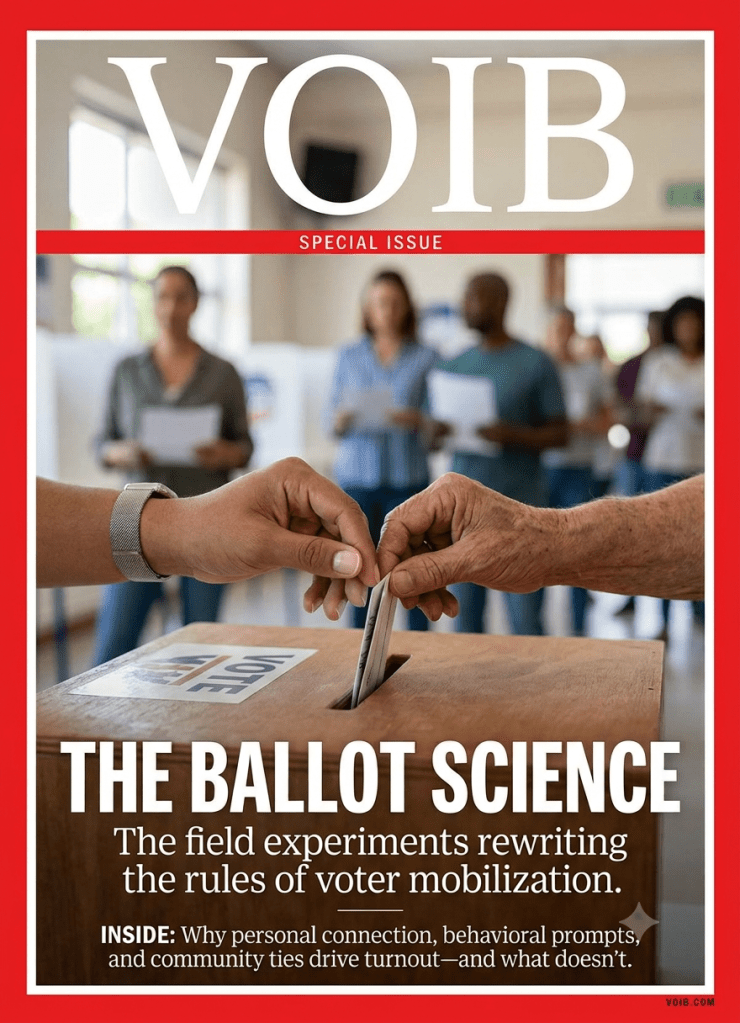
By Saiful Islam
For generations, political campaigns relied on a mix of institutional wisdom, instinct, and financial resources. They sent direct-mail flyers, made generic robocalls to landlines, and strategists believed that victory depended on slick television and blitzes near the end of campaigns.
Then came political scientists with randomized controlled trials.
Over the last twenty years, field experiments have systematically debunked long-standing myths about voter mobilization. Using the same rigorous methods as clinical trials, researchers uncovered a basic truth: personal contact is crucial for encouraging voters, and mass-produced political ads have diminishing effectiveness.
The End of Robocalls
The empirical revolution started when researchers moved away from post-election surveys and began tracking actual voting behaviour through randomized experiments using official records.
The results were quick and striking. Typical outreach efforts—globals, scripted phone banks, TV ads, and online banners—had almost no measurable impact on turnout. Statistically, the effect was negligible.
What truly moves voters is genuine human connection.
Door-to-door canvassing consistently proves to be the most effective tool, increasing turnout by 6 to 10 percentage points among those who answer the door. Informal calls from volunteers produce a solid 3 to 5-point increase.
Assessing Campaign Outreach
* Door-to-Door Canvassing: +6.0 to +10.0 percentage point increase in voter turnout ($12–$20 per additional vote).
* Volunteer Phone Calls: +3.0 to +5.0 percentage point increase ($26–$35 per additional vote).
* Social Pressure Mailers: +2.0 to +8.1 percentage point increase ($1.93–$3.24 per vote).
* Peer-to-Peer Texting: +0.25 to +0.43 percentage points (highly scalable).
* Commercial Phone Banks & Robocalls: No significant impact.
Psychological Factors at the Door
Researchers have also explored why some messages motivate voting while others do not.
One influential factor is social accountability. Since voting records are public, subtle reminders of social norms can significantly boost turnout. Landmark studies showed that mailers displaying a household’s voting history alongside neighbours’ increased turnout by 8.1 percentage points. At under $2 per vote, it’s one of the most cost-effective tactics.
Likewise, simple planning exercises yield big results. Asking voters about their voting plans, how they’ll get there, and their times increased overall turnout by 4.1 percentage points—and by 9.1 points in single-voter households, where natural logistical planning is less common.
However, some popular psychological theories have not held up to testing. Early studies claimed that framing voting as an identity (“being a voter”) rather than an action (“voting”) would boost participation, but larger later studies showed no real difference, advising campaigns to focus on direct engagement instead of linguistic tricks.
Mobilization vs. Persuasion
Perhaps the most uncomfortable truth for campaigners is the difference between mobilizing supporters and persuading voters.
A review of many experiments shows that contact within two months of an election has almost no persuasive effect. In highly partisan elections, most voters’ preferences are already set; out of 800 contacted voters, usually only one switches their vote.
The exception is “deep canvassing”—longer, empathetic conversations where canvassers listen carefully and share personal stories. Unlike quick pitches, deep canvassing can change attitudes on divisive issues for up to nine months.
Looking ahead, the data clearly shows: genuine engagement can’t be automated. Successful campaigns will replace noise with meaningful, structured human connections.

