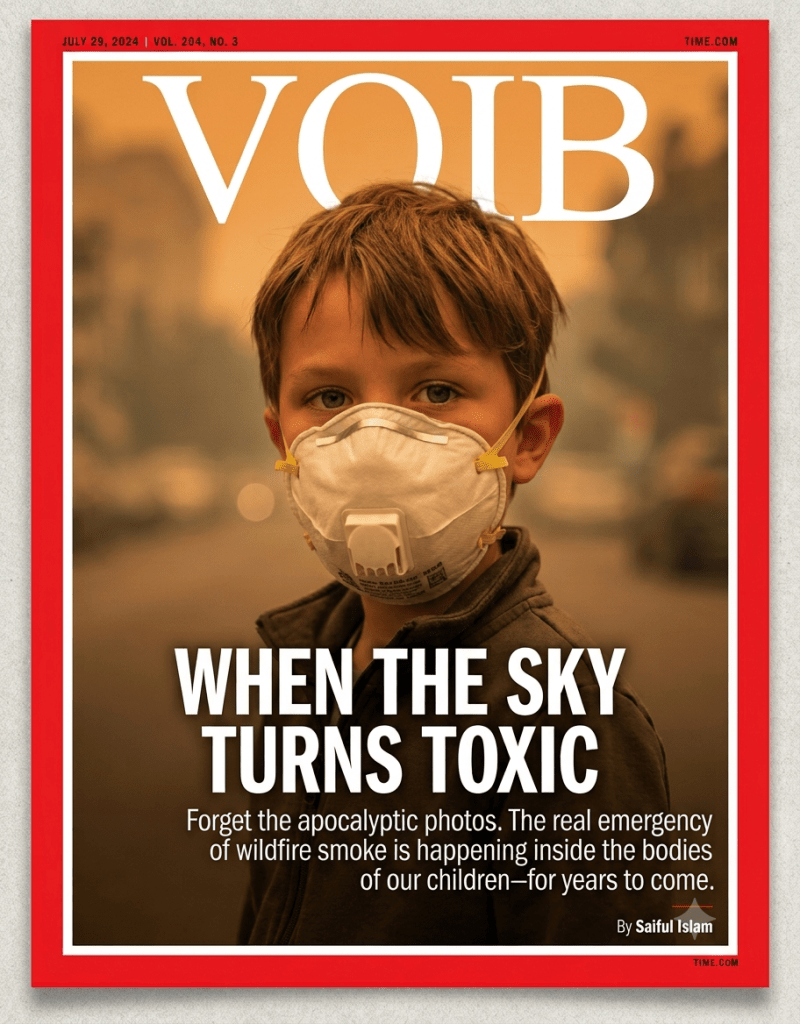
Toxic problem.
It may happen hundreds of kilometres away from the flames.
The forest is burning somewhere beyond the horizon, but the first warning arrives quietly: a strange smell in the morning air. Then the sky changes. Blue becomes gray. Sunlight turns copper. The familiar landscape takes on an eerie, almost cinematic quality.
People shut their windows.
They check the air-quality index.
They wonder whether it is safe to take the children outside.
Then the fire moves on—or the wind changes—and the sky begins to clear.
That is when we make a dangerous assumption.
We assume the danger has passed.
The science tells a more complicated story.
Wildfire smoke is not simply smoke. It is a chemically complex mixture containing fine particulate matter, ozone, carbon monoxide, nitrogen oxides, volatile organic compounds, polycyclic aromatic hydrocarbons and other substances. Among them, PM2.5—the microscopic particles small enough to penetrate deep into the lungs—has emerged as one of the central threats.
And the most unsettling discovery may be this:
The smoke can disappear from the sky before its effects disappear from the body.
The enemy is measured in micrometres
The human eye cannot see PM2.5.
That is precisely what makes it so easy to underestimate.
These particles can travel deep into the respiratory system, reaching the smallest airways and alveolar spaces where oxygen enters the bloodstream. The research describes wildfire-derived PM2.5 as possessing chemical characteristics that can increase oxidative stress and biological reactivity.
The lungs respond as they should: they fight.
Immune cells move in. Inflammatory pathways activate. Chemical signals spread through the tissue.
But unlike a biological pathogen that the immune system can eventually destroy, some particles can remain embedded in lung tissue, sustaining inflammation over time.
That turns a brief encounter with polluted air into something potentially more persistent.
The body remembers what the eye can no longer see.
Children may pay an especially high price
For parents, perhaps the most troubling part of the research concerns children.
The document reports that pediatric asthma exacerbations can be substantially more sensitive to wildfire-derived PM2.5 than to an equivalent concentration of urban particulate pollution.
That matters because children breathe more air relative to their body size and are still developing.
A smoky afternoon that looks like an inconvenience to an adult can become a medical emergency for a child with respiratory vulnerability.
The implication is straightforward: when wildfire smoke arrives, protecting children is not simply a matter of comfort.
It is prevention.
When the forest fire reaches the city
There is another dimension to the problem that is easy to miss.
Wildfires do not always burn trees.
Increasingly, they enter communities.
When flames reach the wildland-urban interface, they can consume houses, vehicles, electronics, furniture, insulation and synthetic building materials. The combustion of these materials can introduce additional toxic compounds, volatile chemicals and metals into the environment.
The result is a new kind of environmental disaster.
A wildfire can contaminate not only the air but potentially soil and water.
The fire may be extinguished.
The environmental consequences may not be.
The lungs are only the beginning
For years, air pollution was discussed primarily as a respiratory problem.
The emerging picture is much larger.
Wildfire smoke can trigger inflammatory processes that extend beyond the lungs. The research associates medium-term exposure with cardiovascular and respiratory conditions including ischemic heart disease, stroke, arrhythmias, hypertension, pneumonia, COPD exacerbations and severe asthma attacks.
The pathway is biological—and frighteningly logical.
Tiny particles enter the lungs.
Inflammation follows.
Some particles and inflammatory mediators can reach the bloodstream.
Blood vessels respond.
The cardiovascular system is stressed.
And the consequences can reach the brain.
The research describes evidence that ultrafine pollutants can cross the blood-brain barrier and activate microglia, contributing to neuroinflammatory processes. Longer-term exposure has also been associated in the document with neurological outcomes, including neurodegenerative disorders and cognitive effects.
The wildfire, therefore, is not merely attacking the organ that first receives the smoke.
It may be challenging the body’s interconnected systems.
The most disturbing part may come later
Perhaps the most important lesson from epidemiology is that timing matters.
Some consequences do not appear immediately.
The research cites longitudinal observations in which measurable declines in lung function became evident one and two years after severe wildfire-smoke exposure, despite relatively limited changes shortly after exposure.
That finding should change the way communities think about wildfire preparedness.
Preparedness cannot begin when the sky turns orange.
It must begin before the smoke arrives.
And recovery cannot be defined simply by the moment the air looks clear.
A crisis measured in lives—and dollars
The numbers are staggering.
The research estimates that long-term wildfire-smoke exposure is associated with approximately 24,100 premature deaths each year in the contiguous United States. Globally, wildland-fire smoke is estimated in the document to contribute to approximately 1.53 million deaths annually.
Canada is not outside this story.
The document reports that more than 80% of Canada’s population experiences seasonal wildfire PM2.5 exposure of at least 1.0 µg/m³. Its estimate of Canada’s annual mortality burden from chronic wildfire-smoke exposure ranges from 660 to 5,400 premature deaths, with an estimated annual health-related economic burden of C$6.4 billion to C$52 billion.
Behind every number is a person.
A parent.
A grandparent.
A child.
A worker who cannot stay home.
A patient whose heart or lungs were already vulnerable.
Statistics tell us the scale of the crisis.
Human beings give those statistics meaning.
Smoke does not affect everyone equally
The phrase “everyone is exposed” can conceal an important truth:
Not everyone is equally protected.
The research identifies heightened vulnerability among economically disadvantaged populations, people with existing cardiopulmonary disease, some racial and ethnic minority populations and remote Indigenous communities that may face greater exposure and limited access to clinical infrastructure.
Wildland firefighters face another level of exposure.
They do not simply experience wildfire smoke occasionally.
For many, smoke is part of the workplace.
The document notes elevated biomarkers associated with premature biological ageing, increased cardiovascular disease incidence and higher career cancer risks among occupational cohorts, consistent with the serious health burden of prolonged firefighting exposure.
The lesson is uncomfortable but necessary:
Environmental disasters often magnify existing inequalities.
The people with the fewest resources may have the fewest options for escaping the exposure.
The room that could save a breath
There is hope—and it is practical.
During severe smoke events, public-health protection can begin inside the home.
The research recommends establishing a designated indoor “clean room”: a space where windows and doors remain closed, outside-air infiltration is minimized, zed and filtration is strengthened through appropriate HVAC operation and portable HEPA air cleaners.
It is a remarkably simple idea.
When the outside becomes dangerous, make the inside safer.
Portable air cleaners can help reduce indoor particle concentrations. Where commercial systems are unavailable, the research describes Corsi-Rosenthal-style filtration units using MERV-13 filters and a box fan as a lower-cost option.
But clean air is not produced by a filter alone.
During smoke events, indoor particle sources should also be minimized. The research specifically identifies activities such as smoking, frying or broiling food, burning candles and vacuuming without appropriate filtration as contributors to indoor particle levels.
In other words, the safest room may be the one where we do less.
Less cooking that creates smoke.
Less outdoor exertion.
Less unnecessary exposure.
More filtration.
More attention.
More preparation.
When you must go outside, some people cannot simply stay indoors.
Healthcare workers still report to hospitals.
Emergency responders still answer calls.
Outdoor workers still work.
And sometimes life itself demands that we leave the house.
During severe smoke episodes, strenuous outdoor activity can increase the amount of polluted air inhaled because breathing becomes deeper and faster.
When outdoor exposure cannot be avoided, respiratory protection becomes important.
The research notes that ordinary cloth and surgical masks provide limited protection against fine particulate matter, while well-fitted N95 respirators can provide substantially greater filtration.
The message is not complicated.
If the air is dangerous, reduce the dose.
Spend less time outside.
Avoid strenuous activity.
Improve indoor filtration.
Use appropriate respiratory protection when exposure is unavoidable.
These are small decisions.
But public health is often the sum of millions of small decisions.
We need to stop treating smoke as someone else’s problem
Perhaps the greatest challenge is not technological.
It is psychological.
Wildfires can feel distant.
A fire in another province, another state or another country seems like someone else’s disaster—until the smoke arrives over our neighbourhood.
Modern wildfire risk is increasingly connected to climate change, land-use patterns, forest management and development in the wildland-urban interface. Yet regulatory systems can struggle to treat wildfire smoke like the major air-pollution event that it has become.
That gap matters.
Because if the air can become hazardous for millions of people, then clean air cannot remain solely an individual responsibility.
It becomes a public responsibility.
Schools need effective filtration.
Hospitals need resilient indoor-air systems.
Long-term-care facilities need emergency smoke plans.
Workers need meaningful protection.
Communities need accessible clean-air shelters.
Governments need policies that reflect the changing scale of the threat.
And vulnerable populations need protection before the first plume arrives—not after the emergency has already begun.
The future will be measured by how well we prepare
There is something strangely hopeful about this story.
The wildfire itself may be beyond our immediate control.
But exposure is not.
Preparation is not.
Public policy is not.
Community resilience is not.
The research concludes that protecting populations will require investment in filtration infrastructure, indoor clean-room protocols, community smoke shelters and targeted measures for communities facing disproportionate exposure.
That gives us a choice.
We can wait for the next orange sky.
Or we can prepare for it.
We can continue thinking of wildfire smoke as an occasional inconvenience.
Or we can recognize it as an emerging public-health challenge.
We can ask vulnerable families to protect themselves alone.
Or we can build systems that make protection possible for everyone.
The difference between those choices may eventually be measured not only in dollars, hospital admissions or air-quality readings.
It may be measured in lives.
The right to breathe
A wildfire reminds us of something fundamental.
Breathing is automatic.
Until it isn’t.
We rarely think about the air entering our lungs with every breath. We do not count the breaths we take while walking through a park, sending a child to school or sitting beside a window.
But when smoke fills the sky, the ordinary becomes precious.
A clean breath becomes something we notice.
Something we protect.
Something we understand we should never have taken for granted.
The science presented in this research should therefore be read not as a prophecy of doom, but as a warning—and a call to action. The danger is real, but so are the tools available to reduce exposure.
We may not be able to stop every wildfire.
But we can build cleaner rooms.
We can protect children.
We can equip workers.
We can strengthen hospitals and schools.
We can design smarter communities.
We can make clean air more accessible.
And we can refuse to accept a future in which breathing safely depends on where someone lives or how much they can afford to spend on protection.
The smoke may be invisible when it first enters the lungs.
But our response does not have to be.
The next time the sky turns gray, the question should not be whether we can see the fire.
It should be whether we are ready to protect the people who cannot afford to breathe it.

