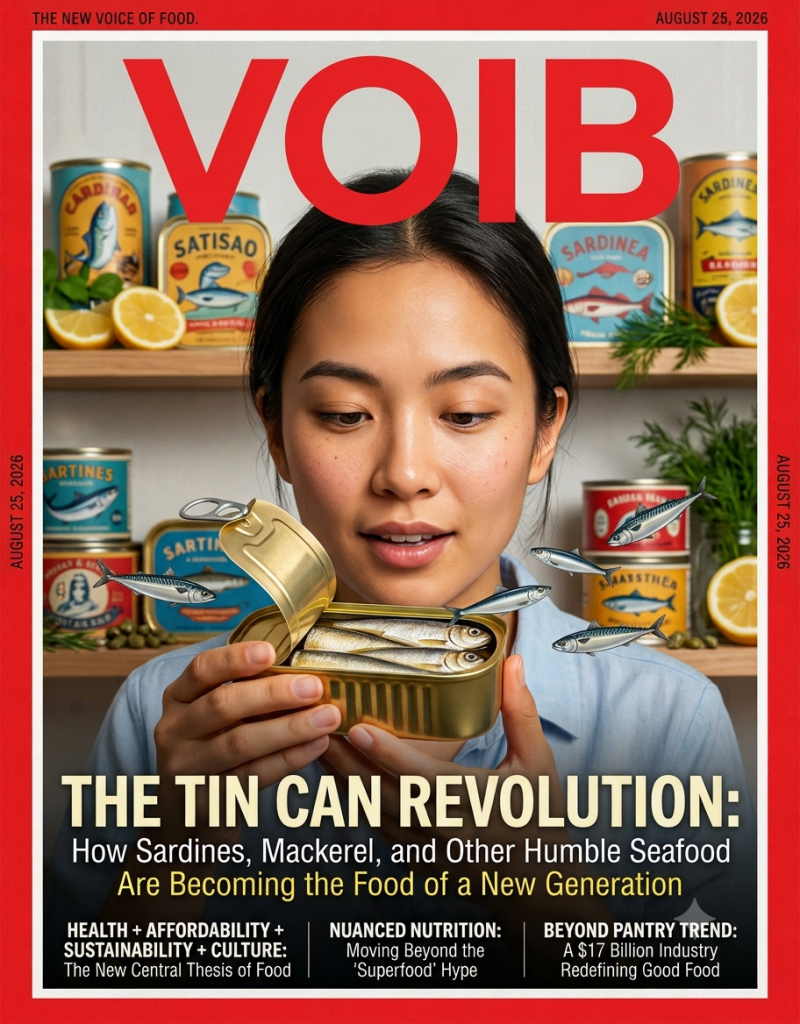
How Sardines, Mackerel and Other Humble Seafood Are Becoming the Food of a New Generation
By Saiful Islam
For most of modern memory, the tin of fish was something you forgot about.
It sat behind the beans and pasta, waiting for a night when the refrigerator was nearly empty, the supermarket was closed or cooking an elaborate dinner felt like too much work. Sardines were practical. Tuna was economical. Anchovies belonged somewhere inside a recipe.
None of them were supposed to be glamorous.
Then something changed.
A small metal tin began appearing on beautifully arranged dinner tables. Sardines were placed beside sourdough, olives and lemon. Mussels arrived in ornate cans. Smoked fish found its way onto elaborate boards. On TikTok and Instagram, opening a tin became a ritual. What had once represented culinary compromise was suddenly being presented as pleasure.
The transformation is easy to dismiss as another social-media food craze.
But that would miss the bigger story.
The revival of tinned seafood sits at the intersection of several powerful forces shaping the way the world eats: the search for affordable protein, growing interest in nutrition, concern about environmental impact, the desire for convenience and a renewed appreciation for traditional methods of food preservation.
The humble tin is having a surprisingly sophisticated moment.
And it may tell us something important about the future of food.
From Emergency Food to Lifestyle Food
The pandemic helped open the door.
When lockdowns disrupted ordinary shopping and dining habits in 2020, shelf-stable foods suddenly became essential. Consumers wanted foods that could survive for weeks or months without refrigeration while still providing meaningful nutrition.
Tinned seafood fit the moment almost perfectly.
It offered protein. It was convenient. It required little preparation. And unlike many emergency foods, it could still be genuinely enjoyable.
Then social media took over.
TikTok and Instagram transformed preserved seafood from something functional into something aspirational. Food creators began sharing “tinned fish date nights.” Chefs demonstrated elaborate-looking meals built around products that required almost no cooking. Colorful cans became part of the visual language of contemporary food culture.
The movement eventually acquired a vocabulary of its own.
There was “seacuterie”—the seafood interpretation of the traditional charcuterie board. There was the romanticized Mediterranean pantry. There was the idea that a simple tin of sardines, a loaf of good bread and a few sharp pickles could constitute an evening worth celebrating.
The source material describes a broader market transformation: the global tinned-fish market was estimated at roughly $9.5 billion in 2022 and is projected to reach $17.2 billion by 2033.
This is no longer merely a pantry trend.
It is an industry.
What Is Inside the Tin?
The cultural story is interesting.
The nutritional story may be more important.
High-quality tinned seafood can deliver an unusually dense combination of complete protein, omega-3 fatty acids, vitamins and minerals. The research in the attached report emphasizes two marine omega-3 fats in particular: EPA and DHA.
These fats are associated with cardiovascular and neurological functions, making oily fish an important part of many healthy dietary patterns.
But not all fish are nutritionally interchangeable.
Consider sardines.
Because canned sardines are commonly eaten with their soft bones and skin, they can provide substantial calcium as well as protein and omega-3 fats. The report notes that a single 3.75-ounce serving can provide up to 44% of the Daily Value for calcium.
Mackerel brings an even more concentrated omega-3 profile. Atlantic mackerel can provide roughly 2,200 milligrams of combined EPA and DHA per four-ounce serving, according to the source material.
Wild canned salmon adds protein, omega-3s and meaningful vitamin D.
Tuna, meanwhile, remains one of the easiest and most economical ways to add protein to a meal.
The lesson is not that one fish is universally “best.”
It is that species matters.
The Mercury Question
That distinction becomes especially important when we talk about contaminants.
Fish live inside food webs, and mercury can move upward through those webs. Larger, longer-lived predatory fish can accumulate more methylmercury than smaller species.
The report identifies albacore, yellowfin and bigeye tuna, king mackerel and swordfish among species that warrant greater attention because of their position higher in the marine food chain. Smaller pelagic fish—including sardines, anchovies and herring—generally have lower contaminant burdens.
This creates a useful rule for the modern seafood shopper:
Don’t just ask whether fish is healthy. Ask which fish.
For many consumers, smaller oily species can offer an attractive combination of omega-3 nutrition and comparatively low mercury exposure.
That does not mean consumers should ignore official seafood-consumption guidance. It means the smartest diet is rarely built around one food eaten without limits.
Variety remains one of nutrition’s oldest and most reliable principles.
The Can Matters, Too
There is another layer to the story that is easy to overlook.
The fish may be nutritious, but what is touching the fish?
Historically, many metal food cans used epoxy coatings associated with BPA-derived materials. BPA has attracted concern because of its potential endocrine-disrupting properties. The report describes the industry’s movement toward BPA-NI, or “BPA Non-Intent,” packaging systems designed without intentionally added BPA.
For consumers, the practical lesson is relatively simple: pay attention to packaging claims and, where available, consider products using BPA-NI linings or glass containers.
The details may sound technical.
But they point toward a larger change in food culture: today’s consumers increasingly want to know not only what they are eating, but also how it was produced, packaged and preserved.
Oil or Water?
Even the liquid inside the tin changes the equation.
Fish packed in extra-virgin olive oil can help protect delicate marine fats during storage, while water-packed products may appeal to consumers seeking lower calorie density. Brined products can contain considerably more sodium.
That means the healthiest-looking label is not always the most informative one.
Look at the sodium.
Look at the species.
Look at the serving size.
Look at the packaging.
And look at the origin.
The new tinned-fish culture is not really about buying the prettiest can. It is about learning to become a more informed consumer.
A Small Fish With a Big Climate Story
There is another reason this revival matters.
Food is not only nutrition. It is also an environmental decision.
The attached analysis compares the carbon footprint of different protein sources and finds a striking contrast: approximately 2.9 kilograms of CO₂-equivalent emissions per kilogram of protein for small pelagic fish, compared with about 60 kilograms for beef, 24 for lamb and 7.5 for pork. Bivalves such as mussels and clams are lower still in the analysis.
Those numbers do not mean that every fishery is automatically sustainable.
They do mean that the choice of protein can have very different environmental consequences.
Small pelagic fish occupy a relatively low position in the marine food chain and can be harvested efficiently. Unlike livestock, they do not require pasture, feed crops or large quantities of freshwater.
And then there is the tin itself.
Canned seafood does not require continuous refrigeration from harvest to supermarket shelf. Its long shelf life can also reduce spoilage and food waste.
That is an underappreciated advantage.
In a world increasingly concerned about food waste and the climate cost of what we eat, preservation suddenly looks less like an outdated technology and more like a piece of the future.
The New Luxury Is Simplicity
Perhaps the most interesting part of the tinned-fish revival is that it does not actually require much cooking.
The fish has already been cooked and sterilized.
The mistake is to treat it like raw seafood that needs to be cooked again.
The report cautions against prolonged high-heat cooking of oily tinned fish because excessive heat can accelerate oxidation of delicate omega-3 fats. Instead, the fish can be eaten cold or at room temperature, or folded gently into a warm dish near the end of cooking.
That makes the tin an almost perfect ingredient for modern life.
Open it.
Plate it.
Add something acidic.
Eat.
A sardine on toasted bread with lemon and capers can be dinner.
So can mussels with pickled onions.
So can smoked salmon with cucumber.
The sophistication lies not in complexity, but in restraint.
The Architecture of a Better Meal
This is where “seacuterie” becomes more than an Instagram photograph.
The attached research suggests a simple culinary principle: rich preserved seafood benefits from acidity, texture and contrast. Lemon, capers, pickled onions, mustard, cornichons and fresh vegetables can balance the richness of oily fish. Toasted sourdough, rye and seeded crackers provide texture.
The result is almost architectural.
Richness.
Acidity.
Crunch.
Salt.
Freshness.
One tin can become the center of an entire meal.
And perhaps that is why the trend feels so contemporary despite being rooted in an ancient technology.
It is food that respects time without requiring much of ours.
The Return of the Pantry
For much of the last century, food culture moved in the opposite direction.
Freshness became a virtue.
Convenience became suspicious.
Preservation was associated with poverty or necessity.
The tinned-fish revival quietly challenges all three assumptions.
Preserved food can be nutritious.
Convenience can coexist with quality.
And inexpensive food can become extraordinary when we understand what to do with it.
That is a powerful idea at a time when many households are confronting higher food costs, busy schedules and growing anxiety about what their diets are doing to the planet.
The tin does not promise perfection.
It offers practicality.
And practicality may be one of the most underrated forms of sustainability.
What the Tin Can Teach Us
The real story here is not that sardines have suddenly become fashionable.
It is that consumers are beginning to redefine what “good food” means.
Good food may be nutritious without being expensive.
It may be convenient without being ultra-processed.
It may be sustainable without being joyless.
It may be beautiful without being complicated.
And it may come in a can.
The attached research concludes that small pelagic fish and bivalves can combine nutritional density with comparatively low environmental impact, while thoughtful species selection, packaging choices and preparation can further improve the benefits of tinned seafood.
That is why the tin deserves a second look.
Not because every can is a superfood.
Not because every fishery is sustainable.
Not because social media has declared sardines fashionable.
But because inside this modest piece of metal is an unusually modern proposition:
Food can be affordable, nutritious, convenient and environmentally conscious at the same time.
The next revolution in food may not arrive in a laboratory or a futuristic kitchen.
It may be waiting on a supermarket shelf.
Quietly.
Patiently.
In a tin.

