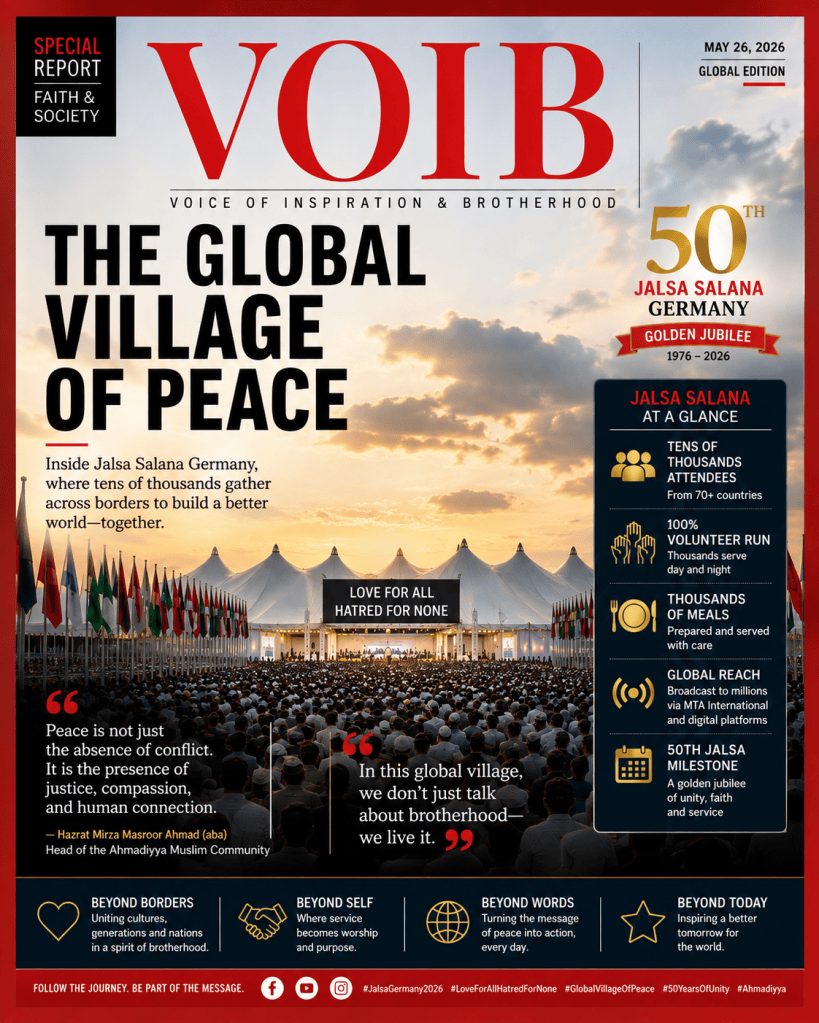
T H E VOIB C O V E R S T O R Y
THE GLOBAL VILLAGE OF PEACE
Inside Jalsa Salana Germany, where thousands gather across borders to test a simple proposition: that peace can be built, one human connection at a time.
SPECIAL REPORT | FAITH & SOCIETY
For a few extraordinary days each year, a temporary city rises on the German landscape.
Tents stretch across the grounds. Kitchens operate around the clock. Volunteers direct traffic, welcome guests, prepare meals, maintain facilities and manage the countless details required to bring tens of thousands of people together.
Then the city disappears.
But its message remains.
In 2026, the Ahmadiyya Muslim Community’s Jalsa Salana Germany marks its 50th annual gathering—half a century of worship, fellowship and service.
Its defining motto is remarkably simple:
Love for All, Hatred for None.
Yet the significance of Jalsa lies not only in what is said from the stage. It is visible in what happens between speeches.
THE ARCHITECTURE OF SERVICE
The most impressive structure at Jalsa may not be a tent at all. It is the network of people who make the gathering possible.
Thousands of volunteers work behind the scenes—serving food, welcoming visitors, maintaining facilities, supporting logistics and helping those in need.
The philosophy is straightforward: service to others is itself an expression of faith.
A meal becomes hospitality.
A task becomes responsibility.
A stranger becomes a neighbor.
In an age of polarization, loneliness and increasingly fragmented communities, that simple model carries a powerful resonance.
A GLOBAL COMMUNITY IN ONE PLACE
Jalsa brings together people of different nationalities, languages, cultures and generations.
For several days, they share prayers, meals, conversations and responsibilities.
The result is more than a gathering. It is a living demonstration of how community can be deliberately built—through trust, discipline, hospitality and mutual service.
And the gathering does not end at the borders of Germany. Through international broadcasting and digital platforms, its message reaches audiences around the world.
FIFTY YEARS—AND A QUESTION FOR THE FUTURE
Half a century on, Jalsa Salana Germany offers a striking counter-image to a divided world.
It suggests that peace is not merely the absence of conflict.
It is a practice.
It is built when people serve instead of simply being served; when strangers sit together; when differences do not prevent human connection.
Eventually, the tents come down. The volunteers go home. The temporary city vanishes.
But the idea remains:
One gathering.
Many cultures.
One human family.
And perhaps that is the enduring lesson of Jalsa:
Peace begins when we choose to build it together.
 Radio VOIB