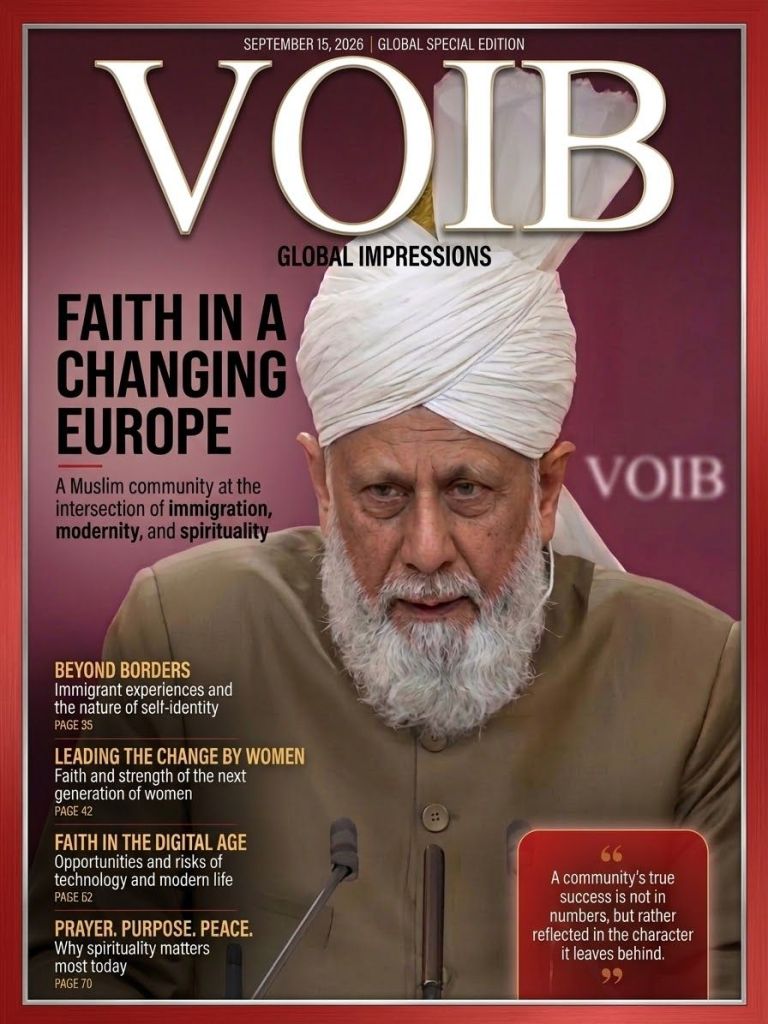
A NEW HORIZON OF FAITH
Migration, Identity and a Quiet Spiritual Awakening in Modern Europe
By Saiful Islam
September 5, 2026
«When people change countries, do they change only their address—or also their faith, identity and sense of purpose?»
THE BIG STORY
Across the German countryside each year, thousands of Ahmadi Muslims gather for Jalsa Salana, an annual religious convention.
Families arrive from cities across Europe. Children run between tents. Young people organize events and services. Older worshippers sit quietly in prayer.
At first glance, it is a religious gathering.
But look closer, and another story emerges—one about migration, identity, modernity and the struggle to keep faith alive in a rapidly changing world.
For many Ahmadi Muslims who left Pakistan for Europe, migration was about more than finding safety and a new beginning. It was also about preserving a religious identity under pressure.
Once settled in Europe, the question changes.
It is no longer simply: How do we survive?
It becomes: How do we remain true to what we believe while fully participating in the society around us?
That question is increasingly relevant far beyond one religious community.
Because material success can provide comfort, education and opportunity. But it cannot, by itself, answer the older human question: What is life for?
EUROPE’S NEW TENSION
Modern Europe has given its citizens extraordinary access to education, freedom, technology and prosperity.
Yet progress has produced its own contradictions.
People have more information than ever, but often less attention. They can communicate instantly across continents, yet loneliness remains widespread. They have unprecedented consumer choices, yet the search for meaning has not disappeared.
For believers, traditional Islamic concepts such as Satan and the Dajjal can also be understood as symbols of powerful temptations that distract people from moral responsibility, self-control and remembrance of God.
Social media offers a striking example.
Technology itself is neither inherently good nor bad. The deeper question is how people use it—and how it begins to use them.
The same smartphone that can consume hours through endless scrolling can also carry Qur’anic teaching, education, history and messages of service to millions.
The challenge, then, is not technology itself.
It is the struggle to protect attention, conscience and values in an age designed to compete for all three.
WOMEN AND THE QUIET ARCHITECTURE OF CHANGE
The future of a society is often shaped in a place that rarely makes the headlines:
the family.
It is at home that children first encounter honesty, responsibility, compassion, forgiveness and respect for others.
Women play a particularly important role in this process.
For Ahmadi Muslim women living in Europe, the challenge can be twofold: embracing education and professional opportunity while maintaining the moral and spiritual foundations of faith.
Islamic history offers an important precedent in Aisha (ra), whose scholarship, transmission of Hadith and contribution to Islamic jurisprudence established her as one of the early Muslim community’s major intellectual figures.
In contemporary Europe, that legacy meets a new reality.
Families experience disagreements. Generations develop different expectations. Cultural identities overlap and sometimes collide.
But every conflict also presents a choice:
Forgiveness instead of retaliation.
Dialogue instead of division.
Self-examination instead of blame.
The way a family handles disagreement helps shape the character of the generation that follows.
A peaceful family, therefore, is more than a happy household.
It can be the first school of a peaceful society.
KNOWLEDGE: THE FIRST DEFENSE OF FAITH
In a modern, pluralistic society, emotion alone cannot sustain a religious identity.
Faith also requires knowledge, reflection and understanding.
Reading the Qur’an is not simply an exercise in pronunciation. It involves understanding its meaning, reflecting upon its teachings and asking how those teachings speak to contemporary life.
Organizations such as Lajna Ima’illah can provide spaces for women’s education, intellectual development, mutual support and community service.
Technology has expanded those possibilities.
Once, religious education depended largely on books, mosques and face-to-face lectures. Today, a lecture, podcast or online class can reach thousands of people across continents within minutes.
Faith may be ancient.
Its methods of communication do not have to be.
But knowledge becomes meaningful only when it changes behavior.
Knowledge can illuminate the mind.
Character makes that light visible.
PRAYER IN A WORLD THAT NEVER STOPS
In modern life, one of the most valuable commodities may not be money.
It may be time.
Work, family, smartphones, emails, social media and endless responsibilities keep the mind in perpetual motion.
For a believer, prayer can create a deliberate interruption—a moment to stop, reflect, give thanks and reconnect with God.
Taqwa, in this sense, is more than fear of God. It is an inner awareness that can guide a person toward integrity even when no one else is watching.
And for children, the most powerful religious education may not come through lectures at all.
It comes through example.
When parents embody honesty, responsibility, prayer, compassion and self-discipline, religion becomes more than an idea in a child’s mind.
It becomes a way of life.
THE GLOBAL QUESTION
The deeper story of Jalsa Salana is therefore not simply how many people gather.
It is what kind of people they hope to become.
When a religious community establishes itself in a new country, it faces a fundamental choice.
It can build a closed world around itself.
Or it can translate its faith into a moral force that allows it to engage, contribute and coexist with the wider society.
The second path is harder.
It demands more than identity.
It demands character.
More than declaring faith.
It demands living it.
More than making a pledge.
It demands honoring that pledge through action.
THE PROMISE
At the heart of the Ahmadiyya Muslim community’s emphasis on Khilafat lies a simple proposition: an ideal survives only when the next generation chooses to carry it forward.
That makes the future of Ahmadi Muslims in Europe about more than demographics or institutional growth.
It is ultimately a question of character.
If a family becomes a center of knowledge, love, prayer and moral discipline, every household can become a small sanctuary of spiritual life.
And perhaps that is where a genuine revolution begins.
Not with a slogan.
Not with triumphalism.
But quietly—
inside the heart of a person who, amid all the noise of the modern world, refuses to forget the One who created it.

