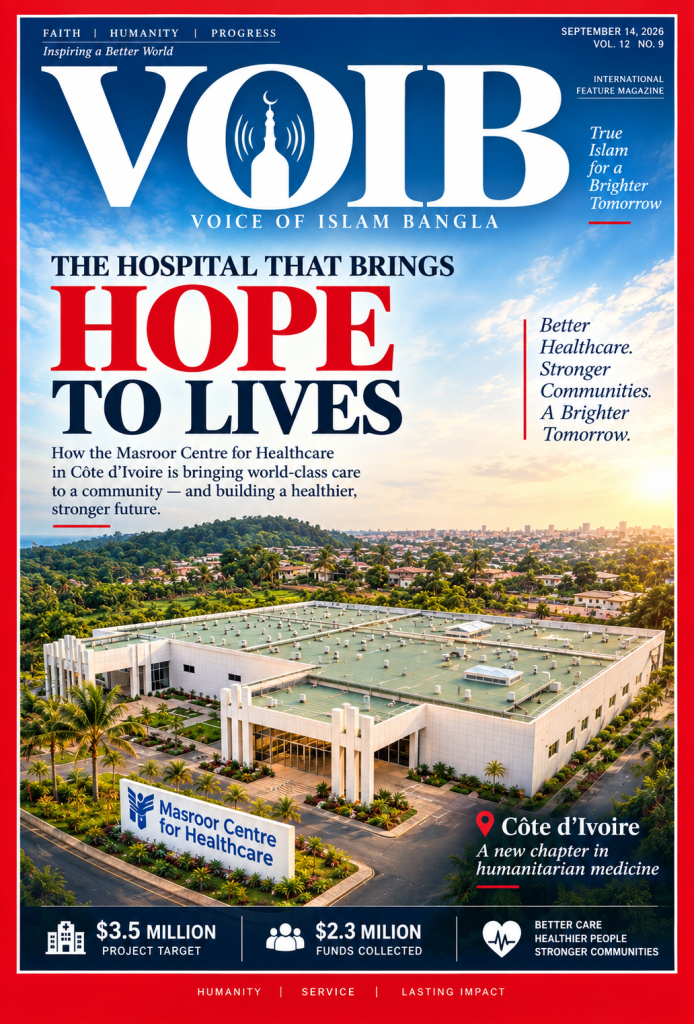
Inside Côte d’Ivoire’s Masroor Centre for Healthcare—and a new vision for humanitarian medicine
By Saiful Islam | September 14, 2026
There are moments when the distance between a hospital and a family is measured not in kilometres, but in consequences.
For a mother in labour, distance can mean danger. For a child centre’s significance. For a patient with a cardiac emergency, it can mean the difference between treatment and tragedy.
In Côte d’Ivoire, those realities have long existed alongside a country undergoing rapid economic and social transformation. More than 28 million people live within a healthcare system still confronting the legacy of political instability, uneven infrastructure and a changing disease landscape. Maternal and infant mortality remain significant challenges, while malaria continues to place extraordinary pressure on medical facilities. At the same time, cardiovascular disease, diabetes, cancer and other non-communicable diseases are rising.
On September 14, a new chapter begins.
In Mahdiabad, in the Yopougon-Gesco district on the outskirts of Abidjan, the Masroor Centre for Healthcare is being inaugurated as a modern, multi-specialty medical institution designed to bring advanced care closer to communities that have historically faced geographical and financial barriers.
But the significance of the centre lies beyond its walls.
It is an attempt to answer a larger question confronting humanitarian organizations around the world:
What if humanitarian aid did not simply respond to suffering—but built the capacity to overcome it?
Where the Need Meets the Opportunity
Yopougon is Abidjan’s most populous municipality, a densely populated urban area that also serves as a bridge toward surrounding communities.
The Masroor Centre was deliberately established on a 3,000-square-meter site to ease pressure on centralized hospitals and bring specialized services closer to people who might otherwise struggle to reach them.
The need is substantial.
The source analysis cites a maternal mortality ratio of 617 deaths per 100,000 live births in 2017. Infant mortality stood at approximately 52.4–58 deaths per 1,000 live births. Immunization gaps left more than 213,000 children under-immunized, including more than 133,000 who had received no vaccinations.
Malaria alone accounted for more than 7.3 million reported cases in the statistics cited by the analysis, with nearly 14,900 registered deaths.
Yet the challenge is no longer defined by infectious disease alone.
The same communities increasingly face hypertension, cardiovascular disease, diabetes, cancer and other chronic conditions.
The result is a double burden: health systems must respond to the emergencies of today while preparing for the diseases of tomorrow.
The Masroor Centre has been designed around that reality.
Four Walls, Many Possibilities
From the outside, it is a healthcare facility.
Inside, its architecture tells a more ambitious story.
A five-bed emergency department is designed for rapid triage, trauma stabilization and resuscitation.
Two operating theatres provide capacity for general surgery, emergency Cesarean sections, pediatric procedures and other specialized interventions.
A four-bed intensive care unit offers continuous monitoring, ventilatory support and critical care.
For mothers and newborns, the centre includes three maternity suites, prenatal and postnatal beds and a neonatal care unit with incubator capacity for premature and low-birth-weight infants.
Then the range widens.
Cardiology.
Gastroenterology.
Pediatrics.
General surgery.
Ophthalmology.
Dental services.
Urology.
Dialysis.
Digital X-ray.
Ultrasound.
Advanced laboratory diagnostics.
An endoscopy suite.
Together, these services represent something more significant than a list of departments.
They represent proximity.
A patient should not have to cross a major city—or leave the country—to find the kind of care needed to confront a serious illness.
The centre’s stated objective is to make that care available closer to home.
The Brick That Started a Journey
Every institution has a moment when an idea becomes physical.
For the Masroor Centre, that moment came on November 27, 2021.
The foundation stone was laid during a ceremony attended by representatives of Humanity First and the Ahmadiyya Muslim Community. A symbolic brick brought from Qadian, India, was incorporated into the foundation.
What followed was less dramatic but perhaps more consequential: years of construction, engineering, fundraising, equipment procurement, clinical preparation and international collaboration.
The structural framework emerged in 2022 and 2023.
The following years brought specialized fit-out, medical-gas infrastructure, diagnostic systems, operating-theatre technology and clinical equipment.
By 2026, the building was ready to become what it had been designed to be—not simply a monument, but a working healthcare institution.
That distinction matters.
A hospital is not created when its doors open.
It is created every time a patient enters them.
The Most Important Equipment Has a Human Face
The most sophisticated machine in a hospital can diagnose a disease.
It cannot replace a trained human being who knows what to do next.
That is why one of the Masroor Centre’s most consequential features may be the least visible from the outside: its investment in people.
The centre’s operational model places local Ivorian physicians, nurses, midwives, laboratory technicians and administrative professionals at the heart of daily healthcare delivery.
International medical specialists are expected to complement those teams through mentorship, skills transfer, clinical training and institutional support.
The distinction is fundamental.
Humanitarian medicine can fly in experts to treat patients.
A stronger model teaches local professionals, strengthens local institutions and leaves expertise behind.
The first approach answers an immediate emergency.
The second can change the future.
The Masroor Centre seeks the second.
From Charity to Capacity
For decades, humanitarian healthcare has often operated under a familiar cycle:
A crisis emerges.
Aid arrives.
Patients are treated.
The visiting teams leave.
The underlying shortage remains.
The Masroor Centre is designed around a different proposition.
Build locally.
Employ locally.
Train locally.
Connect globally.
Then create an institution capable of sustaining itself.
The supplied analysis describes this as a model intended to combine international humanitarian investment with local operational capacity. Its ambition is not to replace Ivorian healthcare professionals with foreign missions, but to strengthen local clinical expertise through sustained collaboration.
That is a subtle but important shift in the meaning of humanitarianism.
The goal is no longer simply to give.
It is to enable.
Can Compassion Sustain Itself?
Perhaps the most difficult question for any humanitarian institution is what happens after the initial generosity runs out.
Buildings require maintenance.
Medical equipment requires servicing.
Doctors and nurses require salaries.
Electricity, medicines, laboratories and clinical supplies require continuing investment.
The Masroor Centre therefore incorporates a three-part sustainability strategy: environmental responsibility, social equity and economic independence.
Its design incorporates natural daylight, landscaped spaces and energy-conscious infrastructure.
Its social strategy emphasizes local recruitment and continuing professional development.
Its economic model seeks to use revenue from specialized and elective services, private accommodation and partnerships to help subsidize emergency treatment, maternal care, pediatric services and care for patients unable to pay.
The principle is simple but powerful:
Sustain the institution so that the institution can sustain the mission.
If successful, that approach could help move humanitarian healthcare away from perpetual dependence and toward institutional resilience.
The Measure of a Hospital
The true test of the Masroor Centre will not be its inauguration.
It will come quietly.
A mother arriving at midnight.
A child whose fever has become dangerous.
A patient whose heart suddenly begins to fail.
A surgeon preparing for an emergency operation.
A premature newborn placed under specialized care.
A family discovering that advanced treatment is available without travelling hundreds of kilometres.
Those are the moments when architecture becomes medicine.
And medicine becomes hope.
A Model Bigger Than Côte d’Ivoire
The Masroor Centre’s broader significance lies in its attempt to combine several ideas that are too often treated separately: emergency care, specialist medicine, local workforce development, international expertise, financial sustainability and social responsibility.
Its designers envision a facility capable of serving tens of thousands of patients annually across the greater Abidjan region.
If that vision becomes reality, the centre could offer lessons far beyond Yopougon.
Humanitarian organizations around the world face the same fundamental challenge: how to turn limited resources into lasting public benefit.
The answer may not always be another temporary medical mission.
Sometimes it may be a hospital.
A permanent institution.
A training ground.
A source of employment.
A centre of specialist knowledge.
A place where international expertise strengthens local capability rather than replacing it.
The Architecture of Hope
There is a temptation to think of humanitarianism as an act of giving: one person helping another, one community helping another, one country helping another.
But the deepest form of humanitarian service may be something more enduring.
It is the creation of conditions in which people can stand stronger tomorrow than they stand today.
That is the larger promise represented by the Masroor Centre for Healthcare.
Its story began with a foundation stone.
It continued through years of work by engineers, medical professionals, volunteers, donors and local communities.
Now it begins its most important chapter—with patients.
Because ultimately, the success of a hospital is not measured in concrete, square metres or equipment.
It is measured in lives touched.
In mothers who return home safely.
In children who survive.
In patients who receive treatment in time.
In doctors who learn.
In nurses who grow.
In families who discover that quality healthcare is not a privilege reserved for someone else.
And perhaps that is the most compelling lesson of all:
Humanitarianism reaches its highest purpose when compassion becomes capacity—and capacity becomes hope.
The Masroor Centre is opening its doors in Côte d’Ivoire.
What happens behind those doors may matter far beyond them.
 Radio VOIB