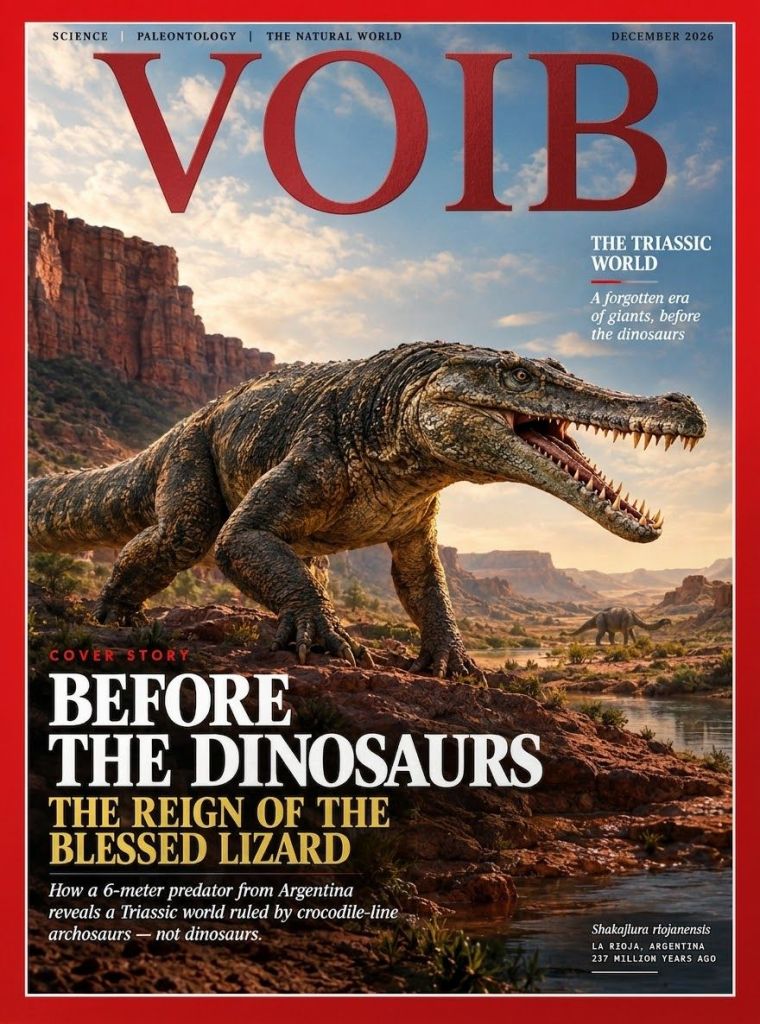
VOIB COVER STORY
BEFORE THE DINOSAURS, THERE WAS A DIFFERENT KIND OF KING
Shakajlura riojanensis, a newly described six-meter predator from Argentina, reveals a Triassic world in which crocodile-line archosaurs—not dinosaurs—topped the food chain.
By Saiful Islam
Science | Paleontology | June 2026
THE WORLD BEFORE THE DINOSAURS
The age of dinosaurs is so deeply embedded in the modern imagination that it is easy to forget something extraordinary:
For millions of years, dinosaurs were not the rulers.
Two hundred and thirty-seven million years ago, in what is now northwestern Argentina, another dynasty ruled the landscape.
There were rivers and floodplains. Volcanic ash drifted across the southern reaches of Pangea. Mammal-line relatives moved through the vegetation. Early dinosaur relatives were present—but they were still relatively small.
And among the largest predators was an animal that looked, in broad evolutionary terms, more like a distant cousin of today’s crocodiles.
It was called Shakajlura riojanensis.
Its name means, approximately, “blessed lizard of La Rioja.”
The name is striking. The animal was even more so.
Researchers estimate that Shakajlura reached roughly 6 meters—about 20 feet—in length, with a skull approaching 60 centimetres. It was not a dinosaur. It was a paracrocodylomorph pseudosuchian, part of the crocodile-line branch of the archosaur family tree.
And its discovery is changing the picture of who controlled the world before the dinosaurs became giants.
I. A SKULL BURIED IN VOLCANIC ASH
The story begins in the rugged badlands of Argentina’s La Rioja Province, inside the region now protected as Talampaya National Park.
During paleontological field campaigns in 2017 and 2018, researchers from the Archosauriform Research Group recovered a collection of fossilized bones from the Chañares Formation.
The specimen—cataloged as CRILAR-Pv 572—included numerous cranial elements along with a small number of postcranial bones.
The fossils were not a complete skeleton.
That makes the discovery all the more remarkable.
From a fragmented skull, jaws, teeth and portions of the rest of the skeleton, researchers were able to recognize an animal that did not fit comfortably within any previously known species.
In June 2026, Ariel F. Cardillo and colleagues formally named it Shakajlura riojanensis in Papers in Paleontology.
The genus name draws from the Kakán language: shakaj, meaning “blessed,” and lura, meaning “lizard.” The species name, riojanensis, refers to La Rioja, the province where the fossils were found.
The result is more than a new name on a paleontological catalogue.
It is a new window into a world that existed long before Tyrannosaurus rex ever walked the Earth.
II. MEET THE SIX-METER PREDATOR
Imagine standing on a Triassic floodplain.
There is no T. rex.
No Velociraptor.
No enormous theropods stalking through the landscape.
Instead, a six-meter-long predator moves across the ancient terrain.
Its body is unknown in every detail, but its bones reveal an animal adapted to a life as one of the major predators of its ecosystem.
Its jaws carried laterally compressed teeth suited to a carnivorous lifestyle. Its skull contained a distinctive combination of anatomical features unlike those of any previously described pseudosuchian.
The researchers identified several characteristics that separate Shakajlura from its close relatives.
Its upper jaw lacked the pronounced surface ornamentation seen in some other crocodile-line archosaurs.
Its nasal bones were comparatively straight.
And its skull contained a distinctive medial shelf on the jugal, an incision in the ascending process of the quadrate, and an unusually enlarged prearticular bone.
These may sound like small details.
In paleontology, they can be everything.
A ridge. A shelf. The shape of a bone surrounding the eye.
Sometimes the identity of an animal that vanished more than 230 million years ago is hidden in precisely those details.
III. THE OTHER GIANT
But Shakajlura did not inhabit an empty world.
It appears to have lived at roughly the same time—and in the same broad ecosystem—as another enormous crocodile-line predator:
Luperosuchus fractus.
That is where the discovery becomes especially intriguing.
Both animals were approximately similar in size, yet their skulls were not identical.
Luperosuchus had a distinctive upward curvature of the nasal region—a feature researchers have described informally as a kind of “Roman nose.”
Shakajlura did not.
Its snout was comparatively straight.
The two animals also differed in the ornamentation of the maxilla and in structures surrounding the eye.
These differences do not, by themselves, prove that the animals occupied completely separate ecological niches. But they demonstrate something important:
The Triassic predator community was more diverse than a simple story of one giant carnivore dominating everything around it.
The Chañares Formation was not merely a place where one large predator happened to live.
It was an ecosystem containing multiple large-bodied archosaurs, each carrying its own evolutionary history.
IV. WHEN CROCODILES RULED THE LAND
The word “crocodile” can be misleading.
Shakajlura was not a giant modern crocodile.
It belonged to a much broader branch of the archosaur family tree—the pseudosuchians, the lineage that ultimately includes living crocodilians.
During the Triassic, that lineage produced an extraordinary variety of forms.
Some were small.
Some were armoured.
Some were aquatic or semi-aquatic.
And some became enormous terrestrial predators.
The researchers describe Shakajlura as one of the top predators known from the Chañares Formation. Its presence adds another large-bodied predator to a community that existed at a crucial moment in archosaur evolution.
That matters because the Triassic was not simply a prelude to the dinosaur age.
It was an evolutionary experiment.
After the catastrophe at the end of the Permian, ecosystems were rebuilding. Different lineages were competing for ecological space. Mammal-line animals, crocodile-line archosaurs and early dinosaur relatives were all following different evolutionary paths.
The future had not yet been decided.
V. THE DINOSAURS WERE THERE—BUT THEY WERE NOT YET GIANTS
This is perhaps the most important correction to the popular image of the Triassic.
The first dinosaurs had already appeared.
But the giant predatory dinosaurs that would later dominate popular culture had not yet emerged.
In the Chañares ecosystem, small dinosaur relatives shared the landscape with much larger crocodile-line predators.
That contrast is what makes Shakajlura so revealing.
Evolution does not move according to a predetermined script.
There was no guarantee that dinosaurs would eventually become the dominant large terrestrial predators.
For a time, another branch of the archosaur family tree was already occupying that ecological space.
The future of the planet was still being negotiated—one species, one environment and one extinction at a time.
VI. THE NAME OF A LOST WORLD
There is something almost poetic about the name Shakajlura.
“Blessed lizard.”
It was named for an animal that disappeared more than 230 million years ago, leaving behind fragments of bone in the rocks of La Rioja.
Those fragments survived volcanic activity, burial, erosion and unimaginable stretches of geological time.
Then, in 2017 and 2018, human hands uncovered them.
Scientists cleaned them.
Measured them.
Compared them.
Placed them into evolutionary analyses.
And eventually, from those pieces, reconstructed a creature that had been absent from the scientific record until now.
The animal itself is gone.
But the bones remain.
And with them comes a message from the Triassic:
The world before the dinosaurs was not waiting for dinosaurs to arrive.
It already had its own kings.
THE LARGER STORY
The significance of Shakajlura riojanensis extends beyond the discovery of a six-meter predator.
The Chañares Formation is one of the world’s important windows into Triassic ecosystems, preserving evidence of mammal-line relatives, early dinosaur relatives, crocodile-line archosaurs and other organisms living in the aftermath of Earth’s greatest mass extinction.
Researchers emphasize that paracrocodylomorphs are particularly valuable because their fossil record is comparatively sparse.
Until Shakajlura was described, only one paracrocodylomorph specimen—Luperosuchus fractus—was known from the Chañares Formation.
Now there are two.
Two predators.
Two sets of bones.
Two clues to a vanished ecosystem.
And together they remind us that the road to the modern world was far stranger than the familiar story of the dinosaurs suggests.
Long before T. rex,
the crocodile line was already hunting at the top.
And in the volcanic rocks of Argentina, one of its forgotten giants has finally returned.
SCIENTIFIC NOTE
Shakajlura riojanensis was formally described by Ariel F. Cardillo, Julia B. Desojo, M. Belén von Baczko, Martín D. Ezcurra, Agustín G. Martinelli, Nahuel Vega and Lucas E. Fiorelli in Papers in Paleontology, Volume 12, Issue 3, 2026. The study identifies the animal as an early-diverging paracrocodylomorph, while noting that an early-diverging position within Loricata cannot be ruled out.
Primary scientific source: “Papers in Paleontology — Cardillo et al. (2026)” (https://reference-url-citation.invalid/10)
 Radio VOIB