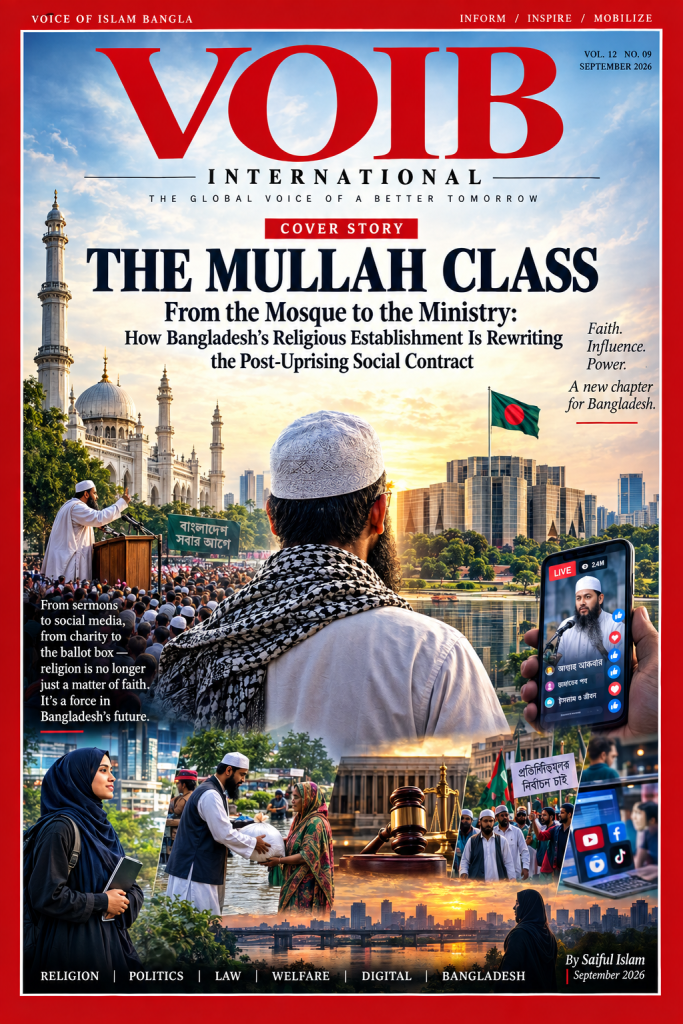
VOIB| COVER STORY
THE MULLAH CLASS
From the Mosque to the Ministry: How Bangladesh’s Religious Establishment Is Rewriting the Post-Uprising Social Contract
In the aftermath of the 2024 uprising, religious authority in Bangladesh is no longer confined to the mosque or the madrasa. It is entering Parliament, the courts, the workplace, the welfare economy and the digital lives of millions—creating a new contest over who gets to define the country’s future.
By Saiful Islam | September 2026
Bangladesh has always been a country where politics travels quickly.
It travels through tea stalls and university corridors, factory gates and village markets, Facebook feeds and Friday sermons. But in 2026, another route has become impossible to ignore: the road from the mosque to the state.
Eight years ago, a religious gathering at Shapla Chattar became a defining confrontation between the state and Hefazat-e-Islam. Today, that history is moving through courtrooms. On October 7, the International Crimes Tribunal-2 is scheduled to hear arguments on framing charges against former Prime Minister Sheikh Hasina and 40 others in the case concerning the 2013 crackdown; prosecutors allege that 58 people were killed in connection with the events.
At the same time, a dispute over something far more ordinary—the legal mechanics of hiba, or gifts of property—has placed religious scholars directly in confrontation with Parliament. Hefazat has demanded amendments to the recently passed Transfer of Property (Amendment) Bill, arguing that aspects of it conflict with the Quran and Sunnah.
These are not isolated episodes.
They reveal a larger transformation.
Bangladesh’s religious establishment is becoming an institution of power.
Not one institution. Not one ideology. Not even one political project.
A constellation.
And the question facing Bangladesh is no longer whether religious actors will influence public life.
It is how far that influence will reach—and where democratic authority will draw the line.
THE WORD “MULLAH” HIDES A MUCH BIGGER STORY
The word mullah suggests a single social type: a bearded cleric, a madrasa teacher, an imam speaking from a wooden pulpit.
That picture is increasingly incomplete.
Today’s religious landscape includes Qawmi scholars and madrasa networks, Sufi political organizations, party cadres, independent preachers, welfare entrepreneurs, online educators and thousands of local imams.
Some mobilize crowds.
Some mobilize votes.
Some mobilize donations.
Some mobilize algorithms.
Some settle village disputes.
And some now speak directly to policymakers.
The result is not a unified Islamist movement. Quite the opposite.
Bangladesh’s religious politics is marked by competition among religious visions of Islam itself.
The Deobandi-oriented Qawmi establishment has its own theological boundaries. Jamaat-e-Islami represents a different tradition of political Islam. Islami Andolan Bangladesh combines religious leadership with electoral politics. Meanwhile, organizations such as the As-Sunnah Foundation represent a more service-oriented, digitally sophisticated model of religious influence.
The rivalry matters.
Because a fragmented religious establishment may be less capable of capturing the state as a single bloc—but more capable of influencing different parts of society simultaneously.
THE NEW RELIGIOUS MAP
Religious current Institutional base Primary arena
Qawmi / Deobandi establishment Madrasa and mosque networks Mass mobilization, religious policy
Sufi political organizations Pir-based networks Elections, grassroots organization
Jamaat-e-Islami Cadre-based political structure Parliamentary politics
Digital religious educators YouTube, Facebook, TikTok Youth, education, public discourse
Faith-based welfare organizations NGOs and foundations Relief, skills, poverty reduction
Local religious authorities Mosques and village networks Mediation and social regulation
The old image of religious power was vertical: imam → congregation.
The new architecture is horizontal:
mosque → Facebook → charity → workplace → political rally → Parliament.
That is the real story.
THE POLITICS OF THE PULPIT
Every evening, somewhere in Bangladesh, a microphone comes alive.
A village field fills with people.
Children sit at the edge of the crowd. Motorcycle headlights illuminate the road. Vendors sell tea. Loudspeakers carry the voice of a preacher beyond the boundaries of the gathering.
The Waz Mahfil has changed.
It is no longer simply a religious lecture.
The modern sermon can move effortlessly from Quranic interpretation to corruption, family life, education, economics, gender relations and political morality.
And then, before the crowd has even gone home, a recording of the sermon can be uploaded.
The village field becomes a studio.
The preacher becomes a broadcaster.
The audience becomes potentially millions.
This is the digital pulpit.
YouTube and Facebook have weakened the old gatekeepers of mass communication. Religious speakers can now build independent audiences without relying on newspapers or television networks.
Their language is equally adaptive.
Arabic quotation.
Urdu aphorism.
Bangla storytelling.
English terminology.
Humour.
Emotion.
Short-form video.
The traditional mimbar has acquired an algorithm.
THE RISE OF “SOFT ISLAMISM”
But perhaps the most important transformation is happening away from the political stage.
It is happening through service.
Consider the model represented by the As-Sunnah Foundation associated with Shaykh Ahmadullah.
Its influence is not primarily built around parliamentary seats.
It is built around relief, skills, charity, public education and digital communication.
That distinction is crucial.
A person who receives a sewing machine through zakat, vocational training through a skills programme, or emergency assistance after a flood is not merely encountering a religious message.
They are encountering an institution.
The political economist might call this social embeddedness.
The believer might call it khidmat.
Either way, the effect is similar:
religion becomes infrastructure.
And infrastructure creates trust.
That puts faith-based organizations into a space historically occupied by secular NGOs and state agencies.
The competition is not necessarily over theology.
Sometimes it is over something much simpler:
Who can help people when they need help?
WHEN PERSONAL LAW BECOMES A NATIONAL QUESTION
The most revealing battles are sometimes fought over the smallest words in legislation.
The Transfer of Property (Amendment) Bill, passed by Parliament in September, introduced provisions concerning property gifts and the rights of donors to retain enjoyment of property during their lifetime. Parliament rejected proposed amendments seeking additional protections connected to Muslim personal law before passing the bill.
Hefazat subsequently demanded changes, arguing that the provisions concerning hiba conflict with Islamic principles and criticizing the government for not sufficiently consulting Shariah experts.
This is bigger than one property law.
It raises a question that every Muslim-majority democracy eventually has to confront:
L
Who has the final word when religious interpretation and statutory law collide?
Parliament?
Courts?
Religious scholars?
Or the citizens themselves through constitutional democracy?
There is no easy answer.
And Bangladesh is discovering that the question cannot simply be avoided.
SHAPLA RETURNS
History rarely disappears.
It waits.
For Hefazat, Shapla Chattar remains a foundational memory of confrontation with the state.
For the prosecution, the 2013 events are now the subject of an international-crimes case.
The tribunal has formally taken cognizance of charges against 41 people, including Sheikh Hasina, and prosecutors have identified 58 deaths connected to the crackdown.
On September 16, the tribunal fixed October 7 for the hearing on framing charges. Thirty accused, including Hasina, remain absconding, according to the prosecution.
The legal process will now have to do something politics often fails to do:
separate memory from evidence.
Families want accountability.
Accused persons have legal rights.
Religious movements want recognition of what they regard as historical persecution.
The state must establish facts through due process.
For Bangladesh, this is more than a courtroom drama.
It is a test of whether the new political order can confront the violence of the old order without creating another version of it.
THE RELIGIOUS ELECTORAL MACHINE
Meanwhile, another transformation is taking place at the ballot box.
Islami Andolan Bangladesh has repeatedly demanded recognition of the July Charter and elections based on proportional representation. Its leaders argue that the existing electoral structure contributed to concentration of political power and that a PR system could produce a more representative Parliament.
In July, IAB also demanded that the election of the next president conform to the July Charter and that constitutional changes precede the presidential election if necessary.
This is not the politics of the old madrasa courtyard.
It is constitutional politics.
Electoral engineering.
Institutional reform.
Political bargaining.
The religious establishment is learning the vocabulary of the modern state—and using it fluently.
—
BUT THE “ISLAMIST BLOC” DOES NOT EXIST
This may be the most important fact of all.
There is no single Islamic political machine waiting to take control of Bangladesh.
There are competing religious movements.
Competing scholars.
Competing theological traditions.
Competing electoral calculations.
And sometimes outright hostility between them.
The Qawmi-Deobandi world and Jamaat-e-Islami do not necessarily share the same theological or political worldview.
Sufi-oriented political movements pursue their own electoral ambitions.
Digital preachers may have enormous audiences without wanting conventional party politics.
Welfare organizations may seek social influence without seeking Parliament.
The religious field is therefore not a pyramid.
It is an ecosystem.
And ecosystems are difficult to control.
—
THE WOMEN WHO ARE NEGOTIATING THE NEW BANGLADESH
There is another story beneath the political one.
Women.
Bangladesh’s transformation has always contained a paradox.
Women have entered factories, universities, offices and public life in unprecedented numbers.
At the same time, religious conservatism has become more visible.
But women are not simply objects of this struggle.
They are actors within it.
For some women, hijab or niqab is primarily an expression of faith.
For others, it may also function as a negotiation with family expectations, social respectability or public space.
For still others, it may have little to do with politics at all.
The important point is that women make these choices themselves.
The danger comes when either the state or religious authority assumes it can make those choices for them.
That is where the debate over religious influence becomes a debate over citizenship.
THE VILLAGE COURT THAT NEVER DISAPPEARED
Travel far enough from Dhaka and another institution becomes visible.
The salish.
A dispute over land.
A family disagreement.
A marriage conflict.
A quarrel between neighbours.
Sometimes the formal court system is years away.
The village imam may be ten minutes away.
That is why informal justice survives.
Not necessarily because people reject the state.
Sometimes because the state is simply too slow, expensive or distant.
But the existence of parallel authority carries a difficult question:
What happens when informal justice contradicts constitutional rights?
Speed is valuable.
Community trust is valuable.
But due process is valuable too.
A democratic state cannot simply ignore the institutions people actually use.
Nor can it surrender the protection of individual rights to whoever happens to possess the greatest local authority.
THE BANGLADESH PARADOX
This is the country that produced one of the world’s most celebrated development stories.
Garment factories.
Microfinance.
Girls in school.
Mobile banking.
A vast migrant workforce.
A rapidly expanding digital economy.
And, simultaneously, an increasingly visible religious public sphere.
The contradiction is only apparent.
Modernization does not automatically produce secularization.
People can own smartphones and attend religious gatherings.
Women can enter universities and wear hijab.
A software engineer can follow a preacher on TikTok.
A factory worker can participate in a union organized around religious identity.
A young entrepreneur can build a business while funding zakat.
Bangladesh is not moving neatly from tradition to modernity.
It is mixing them.
That mixture may be the defining characteristic of the country’s next political era.
FROM MINARET TO ALGORITHM
The old religious establishment had a physical geography.
Mosques.
Madrasas.
Shrines.
Village markets.
The new establishment has a digital geography.
YouTube channels.
Facebook pages.
TikTok clips.
WhatsApp groups.
Livestreams.
Online Q&A sessions.
The preacher no longer waits for the believer to arrive.
The sermon arrives in the believer’s pocket.
That changes everything.
A religious message can now travel faster than a political party.
A clip can reach millions before a newspaper prints a headline.
And a charismatic speaker can build a national constituency without ever contesting an election.
The state has spent decades learning how to regulate institutions.
It is much harder to regulate influence.
THE QUESTION AFTER THE UPRISING
Every revolution eventually faces the same question:
What comes next?
Bangladesh’s uprising dismantled one political order.
But dismantling an order does not automatically create a new one.
The country now has to construct institutions capable of accommodating competing visions of Bangladesh.
Secular.
Religious.
Nationalist.
Liberal.
Conservative.
Urban.
Rural.
Young.
Old.
Majority.
Minority.
The religious establishment will be part of that conversation.
It cannot simply be wished away.
But neither can democratic institutions outsource constitutional authority.
That tension will define the next chapter.
THE NEW SOCIAL CONTRACT
Perhaps the most revealing image of Bangladesh in 2026 is not a politician standing behind a podium.
It is a microphone in a village field.
A smartphone streaming a sermon.
A Parliament debating personal law.
A tribunal hearing testimony about a fourteen-year-old confrontation.
A charity worker delivering a food package after a flood.
A young woman walking through Dhaka wearing a hijab.
A factory worker listening to a religious speaker on the way home.
All of these scenes belong to the same country.
And they are connected by one question:
Who gets to define Bangladesh?
The answer cannot belong entirely to politicians.
Nor entirely to clerics.
Nor to judges.
Nor to activists.
Nor to the algorithms that decide what millions of people see.
A democratic social contract works only when citizens—not institutions claiming superior moral authority—remain the ultimate source of political legitimacy.
Bangladesh’s religious establishment has become too large, too sophisticated and too deeply embedded in society to remain outside the political conversation.
But influence is not sovereignty.
Faith is not legislation.
Popularity is not constitutional authority.
And a microphone is not a mandate.
The country’s great experiment now lies in finding a boundary where religious citizens can participate fully in public life without allowing any religious institution to become the state itself.
That boundary will not be settled by one election.
Or one Parliament.
Or one cleric.
It will be negotiated—perhaps painfully—across villages, universities, factories, mosques, courts and social-media feeds.
Bangladesh has already left the old political order behind.
The question now is what kind of order it builds in its place.
And somewhere between the mimbar and the ministry, the answer is beginning to take shape.
 Radio VOIB