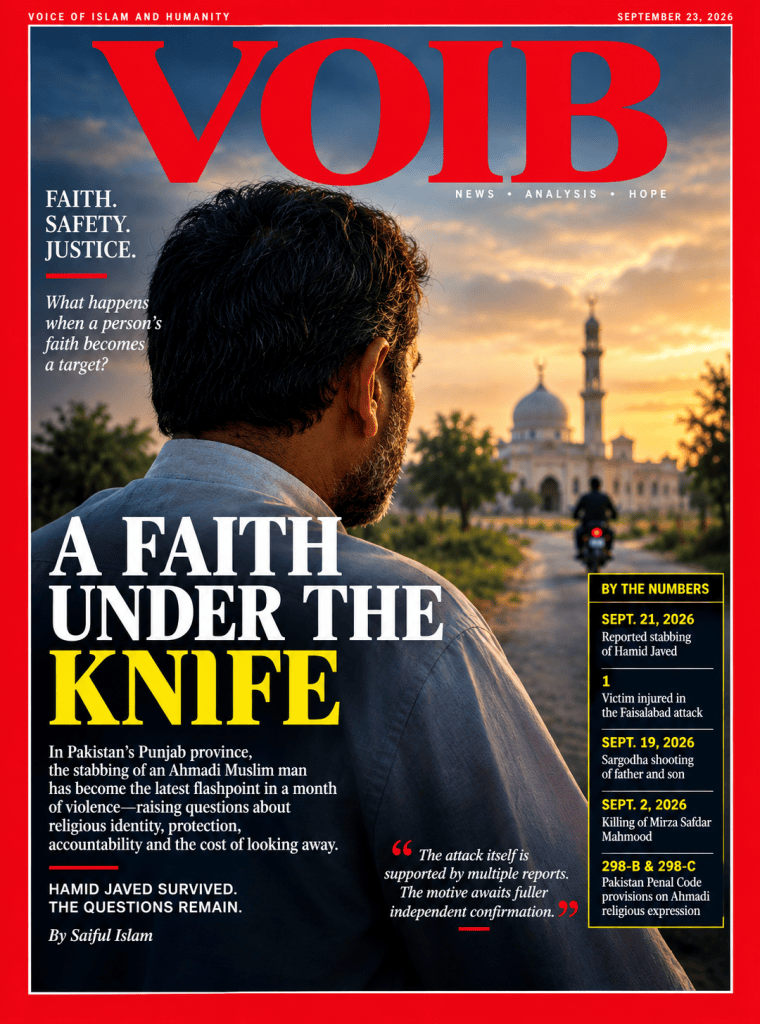
A FAITH UNDER THE KNIFE
In Pakistan’s Punjab province, the stabbing of an Ahmadi Muslim man has become the latest flashpoint in a month of violence—raising questions about religious identity, protection, accountability and the price of looking away.
By Saiful Islam
September 23, 2026
At about 5:30 on a September evening, Hamid Javed was on his way home in LWhy is ita, a rural area of Faisalabad district in Pakistan’s Punjab province.
What happened next, according to accounts cited by minority-rights organizations and Pakistani media, began with a question about identity.
An unidentified man approached Javed near Chak No. 194-RB and asked whether he was a “Qadiani,” a term commonly used in Pakistan for members of the Ahmadiyya community and regarded as derogatory by Ahmadis. Javed confirmed his identity. The man then attacked him with a knife.
Javed was injured.
A nearby resident reportedly intervened with a stick, giving Javed a chance to escape further harm. The attacker fled on a motorcycle.
By the following day, the incident had entered the machinery of the criminal-justice system. A first information report was registered at Khurrianwala Police Station under sections of the Pakistan Penal Code concerning attempted murder and hurt. VoicePk, citing the police report, placed the attack at about 5:30 p.m. and identified the location as near Javed’s residence in Chak No. 194-RB.
But the police record, as publicly reported, did not establish a religious motive.
That distinction matters.
Because the central question surrounding the attack is not simply who stabbed Hamid Javed.
It is why.
THE QUESTION BEFORE THE KNIFE
The account circulated by Voice of Pakistan Minority and reproduced by other rights-focused organizations says the attacker first established Javed’s identity and religious affiliation before striking him. Stop the Persecution, citing the Ahmadiyya Muslim Community UK, reported that a resident also alleged that Javed and another Ahmadi, Tariq Azeem, had previously been warned of danger.
IANS subsequently reported the attack on September 23, citing Voice of Pakistan Minority and describing it as the third reported attack against Ahmadis in Punjab within a month.
Those accounts provide a compelling explanation for why the Ahmadi community regards the incident as faith-related.
But a responsible account must also preserve what remains unresolved.
Multiple reports support the attack itself. The police case is reported. Javed was injured.
The motive, however, awaits fuller independent confirmation.
That gap between what a community believes happened and what an official record formally establishes is at the heart of the story.
It is also where the larger question begins.
THREE ATTACKS, THREE WEEKS
Javed’s stabbing did not occur in isolation.
On September 2, Mirza Safdar Mahmood, 65, an Ahmadi community official, was shot dead in Mandi Bahauddin district after leaving his vehicle workshop. Rights organizations described the killing as faith-related; police described the incident as a suspected targeted killing. Christian Solidarity Worldwide reported that the district police chief told Dawn that the initial investigation suggested Mahmood had been deliberately targeted.
Then, on September 19, Malik Mahmood Mubarak, 70, and his son Ayaz Mubarak, 40, were shot while returning home in Sargodha. Both survived. VoicePk reported that police registered the case under Sections 324 and 34 of the Pakistan Penal Code.
Two days later came the attack on Javed.
Three incidents.
One month.
And, for Ahmadis in Punjab, an increasingly familiar question: How much protection can ordinary life provide when religious identity can itself become a target?
The chronology alone does not prove that the three attacks were coordinated or had identical motives. Investigations would be required to establish that.
But the sequence has intensified concern among rights organizations and Ahmadi community representatives.
A COMMUNITY LIVING INSIDE A LEGAL PARADOX
The violence cannot easily be separated from Pakistan’s unusual legal framework governing Ahmadis.
Pakistan’s Penal Code contains Sections 298-B and 298-C, provisions introduced through legislation in the 1980s that impose criminal restrictions on certain forms of Ahmadi religious expression. Section 298-B restricts, among other things, Ahmadis’ use of certain Islamic religious titles and terminology for their places of worship and call to prayer. Section 298-C criminalizes presenting oneself as a Muslim or preaching or propagating the Ahmadi faith in specified circumstances.
The Pakistani government maintains the legal framework; human-rights organizations and international observers have repeatedly criticized its effects on freedom of religion and belief.
The result is a difficult paradox.
For Ahmadis, religious identity is deeply personal.
In Pakistan, however, aspects of publicly expressing that identity are also regulated by criminal law.
The law does not itself explain every act of violence.
But it forms part of the environment in which questions about identity can acquire consequences far beyond ordinary conversation.
WHEN A NAME BECOMES A TARGET
The most unsettling detail in the Javed case may therefore be the simplest.
According to the reported account, the attacker allegedly asked who Javed was.
Then he asked whether Javed was Ahmadi.
Then came the knife.
If investigators ultimately establish that sequence and motive, the attack would represent something more than random street violence. It would mean that a private religious identity had become the basis for physical targeting.
But that conclusion should come from evidence, not assumption.
For now, the available record supports a narrower statement:
Hamid Javed was attacked with a knife in Faisalabad. He was injured. Police registered a criminal case. Rights and community organizations say his Ahmadi identity was the reason. The investigation must determine whether that allegation can be established.
That distinction is not semantic.
It is the difference between documenting a fact and assigning a motive.
THE COST OF SILENCE
For minority communities, however, fear rarely waits for a completed investigation.
A person does not need to know the attacker’s name to change the route home.
A family does not need a court verdict to wonder whether a warning should be taken seriously.
A community does not need a statistical study to notice when another place of worship, another home or another family becomes the subject of threats.
That is why the September attacks have resonated beyond the individual victims.
The question is not only whether one attacker will eventually be arrested.
It is whether the state can create enough confidence that people do not have to calculate the risks of simply being recognized.
THE ACCOUNTABILITY TEST
Every investigation leaves behind two records.
The first is the legal record: the FIR, the evidence, the arrests, the charges, the testimony and, eventually, the judgment.
The second is the public record: what happened, what was investigated, what remained unexplained and whether those responsible were held accountable.
The Javed case is still at the beginning of that process.
The attacker was reported as unidentified at the time of early reporting. The religious motive had not been formally established in the police account publicly described by VoicePk.
That means several questions remain open:
Who attacked Hamid Javed?
Was the attack planned?
Did the attacker know Javed beforehand?
Were earlier threats made against Javed or Tariq Azeem?
Was Javed targeted specifically because he is Ahmadi?
And will investigators document that motive if evidence supports it?
The answers will determine whether this case is ultimately understood as an isolated assault or as another documented episode of faith-based violence.
THE PATTERN BEHIND THE INCIDENT
There is, however, a larger historical context that does not depend on the outcome of the Javed investigation.
Pakistan’s legal restrictions on Ahmadis are longstanding and documented. International and governmental sources have described limitations on their ability to publicly practice and identify their faith.
Earlier this month, the killing of Mirza Safdar Mahmood produced similar concerns. Police described his death as a suspected targeted killing, while rights organizations identified his Ahmadi identity as a likely motive.
In Sargodha, the September 19 shooting of a father and son added another episode to that growing chronology.
None of these cases should be conflated without evidence.
But neither should each incident be viewed without context.
Patterns are established not by rhetoric, but by evidence accumulated over time: victims, dates, locations, police reports, investigations, court proceedings and verified findings.
That evidence is still developing.
WHAT REMAINS UNKNOWN
The most important facts in the Javed case may still lie ahead.
An arrest could establish the identity of the attacker.
Forensic evidence could illuminate what happened.
Witness testimony could clarify the exchange before the stabbing.
An investigation could determine whether previous threats occurred.
A prosecution could test the evidence.
And a court could ultimately determine criminal responsibility.
Until then, the story should resist two opposite temptations: declaring the motive proven before investigators establish it, or treating the absence of a formally recorded motive as proof that religion played no role.
Both would go beyond the evidence currently available.
THE FINAL QUESTION
On an ordinary evening in Punjab, Hamid Javed was returning home.
A question about who he was allegedly came before the knife.
A neighbour’s intervention may have prevented something worse.
The attacker escaped.
An FIR followed.
And now the case sits at the intersection of two realities: what happened to one man, and what a vulnerable community believes the incident says about the safety of thousands of others.
The test is therefore larger than one arrest.
It is whether an investigation can establish the truth without fear, whether a religious motive—if evidence supports it—will be recorded honestly, whether perpetrators can be brought before a court, and whether Ahmadis can live ordinary lives without having to hide who they are.
For now, the record is incomplete but significant:
A man was stabbed.
He survived.
A case was registered.
The attacker remained unidentified in early reporting.
And a community says its faith was the reason he was targeted.
The next chapter belongs to the investigators, the courts—and the evidence.
Because accountability begins where silence ends.

