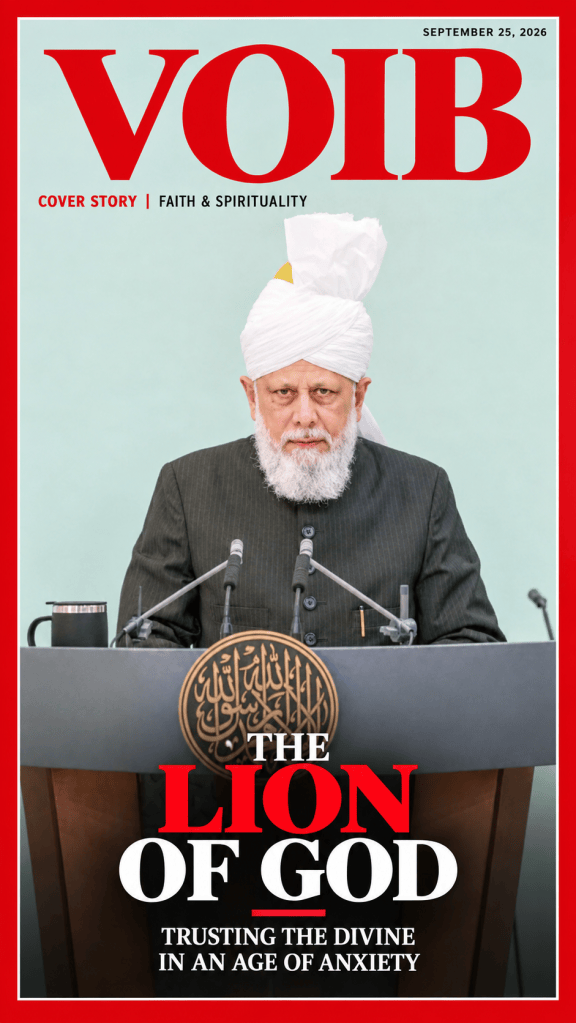
VOIB | COVER STORY
FAITH & SPIRITUALITY
THE LION OF GOD
TRUSTING THE DIVINE IN AN AGE OF ANXIETY
As fear, uncertainty and material insecurity reshape modern life, Hazrat Mirza Masroor Ahmad, Fifth Caliph of the worldwide Ahmadiyya Muslim Community, turns to an older question: What does it mean to trust God completely?
By VOIB Religion & World Affairs Desk
September 25, 2026
THE COURAGE TO LET GO
Every age has its particular anxieties.
Some are measured in collapsing markets, uncertain futures and empty bank accounts. Others are quieter: the fear of losing control, the fear that tomorrow may bring something for which we are not prepared.
On Friday, September 25, Hazrat Mirza Masroor Ahmad (aba), the Fifth Caliph of the worldwide Ahmadiyya Muslim Community, addressed that ancient human anxiety through one of Islam’s central spiritual ideas: Tawakkul—complete reliance upon Almighty God.
But the message was not an invitation to abandon effort.
Quite the opposite.
In the account presented in the sermon, reliance on God begins with responsibility. A believer must employ every legitimate means available, work with diligence and intelligence, and then recognize that the final outcome lies beyond human control.
The distinction is crucial.
Tawakkul is not doing nothing. It is doing everything one reasonably can—and then refusing to let fear become one’s master.
Drawing upon the life and teachings of Hazrat Mirza Ghulam Ahmad of Qadian (as), founder of the Ahmadiyya Muslim Community, Hazrat Mirza Masroor Ahmad described a faith in which human effort and Divine reliance are not opposites but companions.
The believer acts.
The believer prays.
And then the believer trusts.
—
WHEN THE POCKET WAS EMPTY
Few modern instincts are stronger than the desire for financial security.
We save. We insure. We accumulate. We calculate.
Yet the sermon recalled a striking testimony attributed to the Promised Messiah (as): that there were occasions when the complete exhaustion of his material resources produced not despair, but an intensified sense of Divine reliance.
His confidence, according to the account, did not rise and fall with the amount of money in his possession.
Indeed, the emptier the pocket became, the more vividly he experienced dependence upon God.
The image is almost countercultural.
In a society that often equates security with possession, the Promised Messiah’s example reverses the equation. Security, in this spiritual understanding, does not ultimately reside in what a person owns.
It resides in Whom a person trusts.
Sahibzada Mirza Bashir Ahmad (ra), reflecting upon this characteristic, compared it to a subterranean spring. A well may appear completely dry immediately before hidden waters rise from beneath the earth.
So too, the account suggests, an apparently empty hand may precede unexpected provision.
The lesson was not that poverty itself is desirable.
It was that fear of poverty need not become greater than faith in God.
—
WHEN A MISSION CANNOT BE BOUGHT
That confidence was tested in practical affairs.
The sermon revisited an episode connected with Barahin-e-Ahmadiyya, one of the major early works of Hazrat Mirza Ghulam Ahmad (as).
Printing difficulties delayed the work. A subscriber, frustrated by the delay, demanded his money back.
The response was not anger.
Nor was it desperation.
The Promised Messiah (as), according to the historical account, offered to return the man’s money.
The principle behind the response was larger than a publishing dispute. A mission believed to have been entrusted by God could not ultimately depend upon the patience—or impatience—of any individual financier.
The work could be delayed.
The money could disappear.
The circumstances could change.
But the conviction remained.
If the mission belonged to God, its ultimate support had to come from God.
—
“I AM A LION OF GOD”
Then comes the episode at the center of the sermon—a confrontation between spiritual confidence and worldly authority.
According to the account presented, the Promised Messiah (as) faced hostility during a legal dispute in Gurdaspur. A magistrate was alleged to have expressed hostility toward him and confidence that judicial power could bring his opponents under his control.
The news reached the Promised Messiah.
His response, as narrated in the sermon, was striking:
«“Am I his prey? I am no prey—I am a Lion, and a Lion of Almighty God!”»
The statement was not presented as personal bravado.
Its meaning lay precisely in the opposite direction.
The confidence came from the conviction that human power was ultimately subordinate to Divine authority.
He was prepared, the account says, to endure hardship—even imprisonment—for the sake of his faith. But he did not believe that persecution could determine the final outcome of a Divine mission.
The subsequent events, according to the Ahmadiyya historical narrative, included the magistrate’s transfer and the acquittal of the Promised Messiah (as).
Whether read as a story of faith, courage or providential history, its central question remains remarkably contemporary:
What happens to fear when a person no longer believes that worldly power has the final word?
—
IRON BANGLES
There was another warning.
Arrest warrants, it was feared, could lead to handcuffs.
The Promised Messiah’s reported response transformed the threat into an image of spiritual dignity.
People, he observed, wear gold and silver ornaments with happiness.
If believers were to receive iron “bangles” in the path of God, then those too could be worn with honour.
The metaphor is characteristic of the worldview presented in the sermon.
Persecution is not denied.
Pain is not denied.
Fear is not denied.
But their meaning can be transformed.
A chain can become a badge of sacrifice.
A trial can become an opportunity for patience.
An uncertain future can become an occasion for prayer.
The external circumstance remains difficult.
The inner relationship with God changes its meaning.
—
THE BOY WHO WORKED FOR THE KING OF KINGS
Perhaps the most intimate story in the sermon came not from a courtroom but from childhood.
A Hindu neighbor who had known Hazrat Mirza Ghulam Ahmad (as) from his youth reportedly remembered a young man remarkably uninterested in the conventional ambitions of worldly life.
He was not drawn to commerce.
He did not appear eager for political office.
He devoted considerable time to prayer and spiritual reflection.
His father worried about his future.
How would such a young man make a living?
The answer attributed to him was simple:
«“I am an employee of the King of kings and the Lord of the worlds. What need do I have for worldly employment?”»
Years later, according to the account, that same neighbor would speak emotionally of what had become of the young man he had once known.
The man who seemed uninterested in worldly advancement had become the founder of a growing religious movement whose followers were spread across continents.
The story carries an unmistakable irony.
Sometimes the person who appears least interested in worldly success may be pursuing an entirely different definition of success.
—
THE OPPOSITE OF ANXIETY
The sermon ultimately moved beyond nineteenth-century India.
Its subject was not really money.
Or magistrates.
Or publishing delays.
Or even persecution.
Its subject was anxiety.
Human beings cannot eliminate uncertainty. No amount of planning can guarantee tomorrow. Wealth can disappear. Institutions can change. Careers can end. Health can fail. Political circumstances can shift.
Faith, in the theological framework presented by the Caliph, does not promise that believers will never encounter difficulty.
It promises something different:
That difficulty need not destroy their inner equilibrium.
The Promised Messiah (as) expressed the principle in a phrase recalled in the sermon:
«“Whoever becomes God’s, God becomes his.”»
That sentence turns Tawakkul into something more demanding than optimism.
Optimism says tomorrow may be better.
Tawakkul says: Whatever tomorrow brings, I will remain anchored in God.
—
THE MODERN QUESTION
There is something unexpectedly contemporary about this nineteenth-century vocabulary of Divine reliance.
The modern world has more information than previous generations could imagine.
More technology.
More financial instruments.
More systems designed to reduce uncertainty.
And yet anxiety remains stubbornly human.
The spiritual answer offered in the sermon is therefore not a rejection of reason or effort. It is a reordering of priorities.
Work—but do not worship your work.
Plan—but do not imagine that planning gives you control over everything.
Seek provision—but do not make wealth your god.
Defend yourself—but do not believe worldly power is absolute.
Pray—not as an escape from responsibility, but as the final expression of responsibility before the One believed to control the outcome.
This is the architecture of Tawakkul presented by Hazrat Mirza Masroor Ahmad.
—
THE LION AND THE QUIET HEART
The most powerful image from the sermon may therefore not be the lion confronting a magistrate.
It may be the quieter image beneath it:
A human being standing before an uncertain future without surrendering his peace.
The lion is not fearless because danger does not exist.
The lion is fearless because, in the theology of the sermon, God is greater than the danger.
That distinction lies at the heart of the message.
Faith does not necessarily remove the storm.
It changes the position of the person standing inside it.
And for millions of believers listening around the world on September 25, the lesson was direct:
Do what you can.
Pray for what you cannot.
And when the outcome finally leaves your hands, place it in the hands of God.

