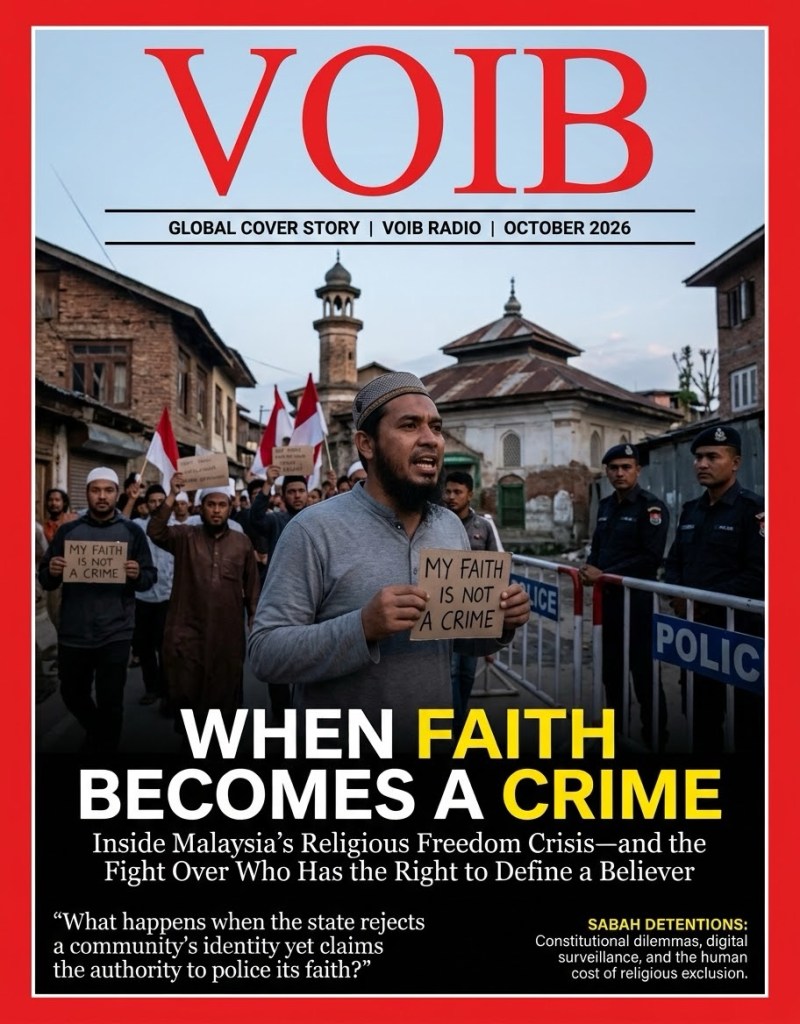
WHEN FAITH BECOMES A CRIME
Inside Malaysia’s Religious Freedom Crisis—and the Fight Over Who Has the Right to Define a Believer
VOIB RADIO | GLOBAL COVER STORY | OCTOBER 2026
Hundreds of Ahmadiyya Muslims were reportedly detained during a religious gathering in Sabah. The incident has exposed a deeper constitutional dilemma: What happens when the state rejects a community’s religious identity yet claims the authority to police its faith?
THE COVER STORY
There are moments when a single event exposes the fault lines running beneath an entire political system.
In Malaysia, one such moment came on May 31, 2026, when authorities reportedly detained hundreds of members of the Ahmadiyya Muslim Community during a religious convention in Sabah.
The gathering was not simply another entry in a government enforcement record. For those who had assembled, it was an expression of religious identity, communal belonging and devotion. For the authorities, the operation formed part of a wider effort to enforce the officially recognised interpretation of Islam.
The reported detention of approximately 300 people brought a difficult question into sharp focus—one that reaches beyond Malaysia, beyond any single religious community and beyond the boundaries of theological disagreement.
Who has the power to determine what a person may believe, how that person may worship, and whether the state can punish peaceful religious expression because it rejects the believer’s understanding of faith?
This is the question at the heart of Malaysia’s Ahmadiyya controversy.
It is also a test of something larger: whether constitutional guarantees of religious freedom retain their meaning when a minority’s beliefs conflict with the doctrine endorsed by public authorities.
The answer matters not only to Ahmadis. It matters to every society in which religious identity, political authority and individual conscience intersect.
CHAPTER ONE
Sabah: When a Religious Gathering Became a National Question
According to reporting cited in the research for this article, the May 31 operation involved the Sabah Islamic Religious Affairs Department, known as JHEAINS, and the Royal Malaysia Police, or PDRM. Approximately 300 Ahmadiyya participants were reportedly detained during the community’s 32nd annual convention, Jalsa Salana.
The detainees were taken for documentation and investigation under the applicable state religious-law framework before being released on bail, according to the supplied accounts.
The scale of the operation made it especially significant. A gathering intended to bring members of a religious community together had become the subject of a major law-enforcement intervention.
The incident raised questions that cannot be answered simply by invoking official religious doctrine. What legal provisions justified the operation? What conduct was alleged to have violated those provisions? What opportunities did the detainees have to challenge their treatment? And what safeguards exist to protect peaceful religious assembly?
These are questions of law, evidence and accountability.
They should be answered through transparent reporting, access to legal remedies and independent judicial scrutiny—not through assumptions about the legitimacy or illegitimacy of a community’s beliefs.
The controversy gained further national attention in July, when Religious Affairs Minister Dr. Zulkifli Hasan addressed enforcement against teachings considered deviant during a parliamentary session. Contemporary reporting described a coordinated government approach involving federal agencies, state religious departments and law-enforcement bodies, alongside efforts to limit the online spread of teachings deemed contrary to the official religious framework.
The government’s stated objective is to uphold its recognised religious standards. The question for constitutional scrutiny is whether the means employed remain within the limits imposed by law and fundamental rights.
A state may regulate conduct under valid laws. But the existence of a law does not eliminate the need to examine its constitutional limits, its application and its consequences for the people subjected to it.
CHAPTER TWO
The Paradox of Religious Identity
The Ahmadiyya Muslim Community considers itself Muslim. Its members understand their faith through their own interpretation of Islamic teachings, including their beliefs concerning the Promised Messiah, Hazrat Mirza Ghulam Ahmad.
Malaysian religious authorities have adopted a different position, classifying Ahmadiyya teachings as deviant from the officially recognised understanding of Islam.
The theological disagreement is longstanding. The constitutional implications are immediate.
When an official religious classification influences whether people may assemble, distribute literature, use religious terminology or maintain places of worship, a doctrinal dispute becomes a question of public power.
The central difficulty is the relationship between religious exclusion and legal jurisdiction.
If authorities maintain that Ahmadis fall outside their recognised definition of Islam, what legal basis permits those same authorities to exercise religious jurisdiction over them? Conversely, if Ahmadis are treated as persons subject to Islamic-law enforcement, how should the state reconcile that treatment with its official rejection of their religious identity?
The answer cannot be established through rhetoric alone. It requires careful examination of the relevant fatwas, state enactments, constitutional provisions and judicial decisions.
Yet the underlying contradiction demands attention.
A system in which a minority is excluded from an officially recognised religious category while remaining vulnerable to enforcement under religious laws risks creating uncertainty about both status and rights.
For individuals, such uncertainty can mean not knowing which protections apply, which authorities possess jurisdiction or how to challenge an adverse decision.
For the state, it creates a serious test of legal consistency.
Religious authorities may define their theological positions. The legal consequences of those positions, however, must remain subject to the Constitution and the courts.
CHAPTER THREE
Article 11 and the Promise of Constitutional Freedom
Malaysia’s Federal Constitution recognises religious freedom under Article 11(1), which provides that every person has the right to profess and practise their religion, subject to the other constitutional provisions and applicable legal limitations.
The words matter.
Religious freedom is not an unlimited exemption from every law. Governments retain lawful responsibilities, and constitutional disputes require attention to the specific legislation, circumstances and judicial precedents involved.
But neither can religious freedom be reduced to a privilege available only to communities whose beliefs enjoy official approval.
The question is whether restrictions on a minority’s religious practice have a valid legal foundation and are consistent with the constitutional framework.
That question becomes especially urgent when peaceful worship is the conduct at issue.
The constitutional challenge facing Malaysia is therefore not simply whether state authorities have religious responsibilities. It is whether the exercise of those responsibilities respects the rights and legal status of the individuals concerned.
A meaningful guarantee of religious freedom must be capable of protecting people in precisely the circumstances in which protection is most contested.
Otherwise, constitutional rights risk becoming strongest for those who need them least.
CHAPTER FOUR
The Courts, the Constitution and the Limits of State Power
Malaysia’s dual legal system divides jurisdiction between civil courts and Syariah courts. The Federal Constitution allocates legislative authority between federal and state governments, while limiting state legislative competence over Islamic law and the jurisdiction of Syariah courts.
These constitutional boundaries are central to disputes involving Ahmadiyya Muslims.
The supplied research identifies litigation following a 2014 raid by the Selangor Islamic Religious Department, or JAIS, on an Ahmadiyya community centre in Kampung Baru Subang. The proceedings raised questions about the authority of religious enforcement officers and the extent to which civil courts could review administrative actions affecting Ahmadis.
The wider issue is fundamental: who determines whether an authority has acted within its lawful jurisdiction?
A constitutional system requires courts that can independently examine such questions. Administrative decisions, religious classifications and enforcement actions cannot be treated as immune from legal scrutiny simply because they arise from a religious-administration framework.
At the same time, the precise effect of any particular judgment must be established from the actual decision, subsequent proceedings and relevant legislation. A ruling on jurisdiction does not automatically settle every question about religious freedom, nor does it establish that every subsequent enforcement action is unlawful.
The appropriate response is careful legal analysis—not exaggeration and not silence.
The broader principle remains clear: public power must have a lawful basis, remain within constitutional limits and be open to independent review.
For Ahmadiyya Muslims, effective judicial remedies may be essential to protecting their rights. For Malaysia, respect for independent judicial scrutiny is essential to maintaining confidence in the rule of law.
CHAPTER FIVE
The Human Cost Behind the Legal Language
Legal categories can make human experiences seem remote.
Words such as deviant, non-orthodox, jurisdiction and enforcement appear in official documents. But their consequences are experienced by people.
A parent may worry about a child attending a religious gathering. A community organiser may question whether a meeting will lead to detention. A family may fear that openly expressing its beliefs could create legal or social difficulties.
These are not claims that every Ahmadiyya family in Malaysia has experienced each of these circumstances. They are the practical risks that deserve investigation whenever peaceful religious expression becomes a potential target of enforcement.
The wider social environment matters as well. Official labels can influence public perceptions of minority communities. When people are repeatedly described as religiously illegitimate, there is a risk that theological disagreement will be transformed into social suspicion or exclusion.
A society committed to peace must resist that progression.
The answer is not to prohibit religious disagreement. Freedom of expression includes the ability to debate theology, criticise doctrines and defend competing interpretations.
The boundary is the treatment of people.
Disagreement over belief should not become a justification for intimidation, discrimination or the denial of equal protection under the law.
A person’s dignity does not depend on whether the majority agrees with that person’s theology.
CHAPTER SIX
Refugees: Escape from Persecution, Arrival into Uncertainty
For some Ahmadiyya Muslims, the Malaysian controversy intersects with another crisis: displacement.
Pakistani Ahmadis have faced longstanding discrimination and legal restrictions in their country of origin. Some have sought refuge abroad to escape threats, harassment or persecution associated with their religious identity.
Malaysia is an important destination and transit country for displaced people, but it is not a party to the 1951 Refugee Convention or its 1967 Protocol and lacks a comprehensive domestic asylum framework.
Consequently, refugees may face insecure legal status, immigration enforcement risks and substantial barriers to formal employment and education.
For an Ahmadiyya refugee, religious vulnerability can compound these challenges. Someone who has fled persecution may remain uncertain about where to worship, how to seek assistance or whether approaching an authority could expose the person to further difficulties.
These circumstances require evidence-based investigation and a careful distinction between documented cases and broader systemic risks. They also require a serious policy response.
Governments should be able to manage immigration while ensuring that vulnerable people have access to appropriate protection procedures, legal assistance and safeguards against exploitation.
The international community should press for credible documentation of alleged abuses and practical improvements in refugee protection.
Protection should not depend on whether a person’s beliefs are popular in the country where refuge is sought.
CHAPTER SEVEN
The New Frontier: Faith Under Digital Surveillance
Religious communities no longer depend exclusively on physical meeting places. Online platforms, messaging services and digital educational resources allow people to exchange ideas, maintain communities and learn about religious teachings across borders.
Malaysia’s announced efforts to curb online dissemination of teachings deemed deviant bring this expanding digital environment into the controversy.
Governments have legitimate reasons to address unlawful conduct online. But measures directed at peaceful religious expression require particular care.
When digital monitoring is used to identify and restrict religious material, several questions arise.
What standards determine whether content is unlawful? Are the criteria publicly available? Can individuals challenge mistaken classifications? Are restrictions limited to legitimate objectives? What safeguards protect private communications and prevent disproportionate interference with freedom of conscience?
These questions are not unique to Malaysia. They confront governments worldwide as technology expands the reach of public authority.
The danger is that the monitoring of genuinely harmful conduct can become entangled with the suppression of peaceful disagreement.
A constitutional society must preserve the distinction.
Religious education, theological debate and peaceful advocacy should not automatically be treated as threats merely because their content conflicts with an official interpretation.
The challenge is to regulate demonstrable unlawful conduct without turning religious conformity into a condition of peaceful participation in society.
CHAPTER EIGHT
Five Steps Toward a More Just Future
The way forward need not be defined by confrontation. It can be defined by legal clarity, accountability and the protection of human dignity.
1. Independent judicial review
Ensure that detentions, prosecutions and administrative restrictions are subject to effective legal challenge before competent courts. Publish relevant decisions and clarify the legal grounds for enforcement.
2. Clear protection for peaceful religious practice
Review laws and enforcement practices that may penalise peaceful worship or expression solely because a community’s beliefs differ from officially accepted doctrine. Ensure that any restrictions have a valid legal basis and comply with constitutional protections.
3. Transparency and accountability
Provide reliable public information about arrests, allegations, legal proceedings and enforcement outcomes. Independent scrutiny should be possible without compromising legitimate privacy protections or the presumption of innocence.
4. Effective safeguards for refugees
Improve access to legal advice, protection procedures and essential services for refugees who face risks because of their religious identity. Ensure that immigration vulnerability does not prevent people from seeking help when they fear persecution or exploitation.
5. Constructive dialogue and international engagement
Encourage engagement among religious scholars, minority communities, civil society, government institutions and international human rights bodies. Peaceful theological disagreement should be met with dialogue and lawful protections rather than unnecessary coercion.
These steps do not require a society to abandon its religious traditions. They require public institutions to demonstrate that religious governance can operate consistently with constitutional accountability.
The objective is not to silence religious authorities. It is to ensure that the rights of individuals remain protected even when religious authorities and minority communities disagree.
CHAPTER NINE
Malaysia’s International Test
Malaysia’s treatment of religious minorities carries implications for its international reputation and for broader debates about religious freedom.
The United States Commission on International Religious Freedom has raised concerns about restrictions affecting religious minorities in Malaysia and recommended increased international scrutiny.
Such assessments should be considered alongside primary documents, applicable laws, court decisions and responses from Malaysian authorities. International engagement is strongest when it is accurate, consistent and directed toward practical improvements.
The Sabah detentions offer an opportunity to examine whether Malaysia’s enforcement framework adequately protects peaceful religious expression and provides meaningful legal remedies.
International attention should focus on verifiable facts: the circumstances of detention, the legal grounds invoked, the treatment of those detained, the availability of judicial review and the outcomes of any proceedings.
It should also distinguish between a government’s stated objectives and the actual effects of its policies.
A country’s religious heritage and constitutional obligations need not be treated as opposing forces. The real test is whether institutions can uphold their religious and public responsibilities without undermining fundamental legal safeguards.
For Malaysia, this is an opportunity to demonstrate that constitutional government can protect social stability while respecting religious diversity.
For the international community, it is an opportunity to insist that freedom of conscience is a universal principle, not a reward reserved for approved beliefs.
THE FINAL WORD
The Measure of a Society
The story of Malaysia’s Ahmadiyya community is about more than a dispute over religious doctrine.
It is about the boundary between authority and conscience. It is about whether a minority can peacefully maintain its identity when that identity is rejected by official institutions. It is about whether constitutional rights remain effective when exercising them becomes difficult.
Governments can administer religious affairs. Religious scholars can defend their interpretations. Citizens can disagree passionately about the meaning of faith.
But none of those realities removes the need for lawful authority, independent judicial scrutiny and respect for human dignity.
The events reported in Sabah demand careful examination. They deserve transparent answers, reliable documentation and a legal process in which the rights of every person are taken seriously.
No responsible assessment should prejudge the outcome of individual legal proceedings. Nor should the complexity of the law become an excuse to ignore the fundamental questions raised by the treatment of a vulnerable religious minority.
The challenge is to build a society in which disagreement does not automatically produce exclusion, in which public power remains accountable, and in which peaceful worship is not treated as a threat simply because it falls outside an official religious consensus.
This is not a demand that everyone agree about religion.
It is a demand that disagreement be handled justly.
And it is a principle that belongs to no single community, nationality or faith.
The ultimate measure of religious freedom is not whether the majority is permitted to practise its beliefs. It is whether those whose beliefs are rejected by the majority can live, worship and seek justice without fear.
VOIB RADIO | A CALL TO CONSCIENCE
Read beyond the headlines. Examine the evidence. Listen to affected communities. Demand accountability through peaceful and lawful means.
Share verified reporting. Support freedom of conscience. Stand for due process and equal human dignity.
Because religious freedom is not tested when everyone agrees. It is tested when a person’s right to believe is challenged.
EDITORIAL SOURCES
- The Star, July 17, 2026 — “JAKIM out to curb online spread of deviant teachings.”
- U.S. Commission on International Religious Freedom — 2025 Malaysia Country Update.
- The Malaysian Reserve, July 16, 2026 — “Govt strengthens enforcement, rehabilitation against deviant teachings.”
- Christian Solidarity Worldwide — reporting on Ahmadi refugees in Thailand and Malaysia.
- Federal Constitution of Malaysia — Article 11 and the Ninth Schedule.
- Relevant Malaysian civil-court judgments, state religious enactments and gazetted fatwas, to be consulted in their original form before publication of detailed legal conclusions.

