THE SILENCE OF THE SCAFFOLD
When a foreign execution shatters the illusion of state protection, the invisible cost of remittance, and the crisis of expatriate rights.
By VOIB
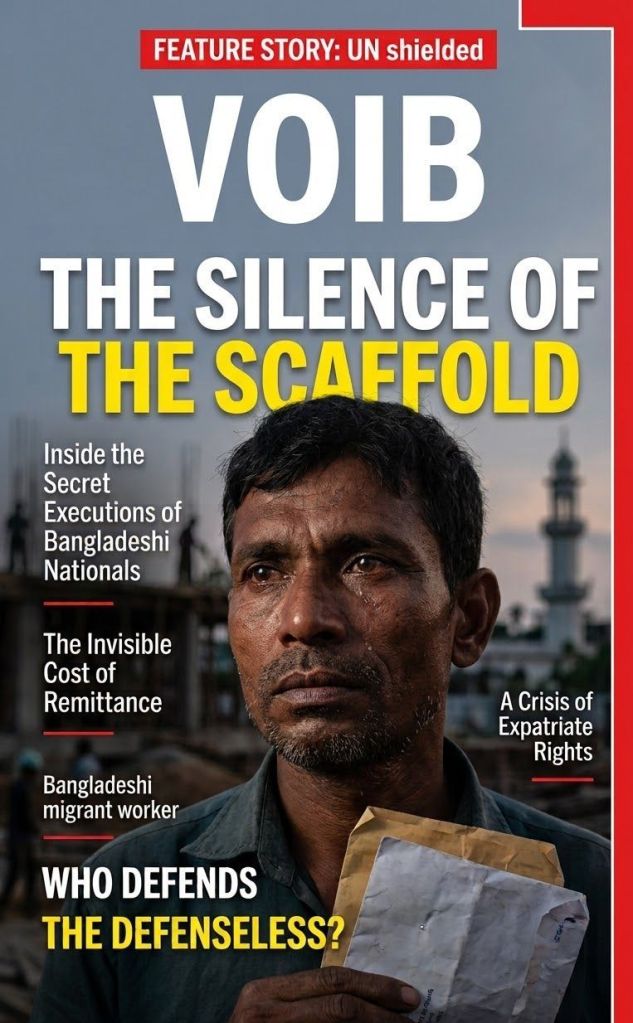
In the quiet hours of an October morning in Riyadh, two young Bangladeshi citizens—a man and a woman—faced the final, absolute arbitration of Saudi Sharia law. Accused of an alleged desecration inside a sacred precinct in Mecca, their lives were abruptly extinguished beneath the executioner’s blade.
Yet, for days following their deaths, the nation they called home remained entirely in the dark.
When the news finally breached diplomatic channels and flooded social media networks across Dhaka, it did not arrive as an official notification from the Ministry of Foreign Affairs, but as a grim post-execution bulletin. The government of Bangladesh, home to over 3 million expatriate workers in the Kingdom, appeared caught entirely unawares.
The incident—unpacked in a recent investigative broadcast by NewzyChat featuring Supreme Court barrister Miti Sanjana—has triggered a fierce national reckoning. It lays bare an agonizing paradox at the heart of the modern global economy: nations that feed on the billions remitted by their diaspora often abandon those same citizens when the machinery of foreign justice grinds them into dust.
The Anatomy of an Omission
According to accounts from Saudi authorities, the young couple allegedly violated strict religious codes by engaging in “immoral conduct” inside a Mecca mosque. Under the Kingdom’s Tazir provisions—a category of discretionary punishment under Sharia law where statutory texts do not explicitly fix sentences—judges hold sweeping authority to mete out capital punishment for acts deemed a severe affront to public morals or religious sanctity.
The trial, conducted in the shadows over several months, proceeded without meaningful consular visibility. Under Article 36 of the Vienna Convention on Consular Relations, a host state is legally bound to notify a foreign national’s embassy immediately upon arrest, ensuring access to legal representation and a fair defence. Yet, as reports emerged, the Bangladeshi embassy in Riyadh was left blind.
“This is a barbaric act in the 21st century,” Barrister Miti Sanjana told NewzyChat, questioning the core transparency of the judicial process. “Even if we set aside the ambiguity of the charges, where was the right to a fair trial? Where was the legal counsel? Where was the state?”
Diplomatic correspondence reportedly indicates that the embassy received a routine list of roughly 2,500 Bangladeshi nationals currently held in Saudi prisons last September—a roster that included the names of the two executed individuals. Yet, embassy officials allegedly failed to flag the gravity of their charges or anticipate the impending capital sentences. Critics argue this institutional oversight reflects a systemic numbness within diplomatic missions overwhelmed by sheer numbers and conditioned to treat human lives as administrative entries.
The Remittance Trap: Workers or Commodities?
The tragedy has reignited intense debate over the vulnerability of low-wage migrant workers from the Global South. Millions from impoverished families across South Asia and East Africa sacrifice their meagre assets, land, and futures to buy passage to the Gulf, driven by the dream of economic survival.
The economic contribution of these workers is staggering. Remittances form the lifeblood of Bangladesh’s foreign exchange reserves. Yet, human rights organizations—including Amnesty International and Human Rights Watch—have repeatedly highlighted how these workers exist in a precarious legal limbo.
Behind the gleaming skyscrapers of Riyadh and Jeddah lies an archaic sponsorship (Kafala-adjacent) system where passports are routinely confiscated, wages are withheld, and basic labour protections are minimal. Female domestic workers frequently report enduring severe psychological, physical, and sexual abuse. When desperate victims seek help from local police stations, language barriers, institutional apathy, and the threat of retaliatory counter-charges—such as illicit pregnancy or zina (consensual extramarital relations)—often trap them further.
“When bodies return in coffins labelled with vague explanations of ‘natural death’ or ‘heart failure,’ subsequent autopsies in Bangladesh frequently reveal unmistakable signs of physical trauma,” Sanjana noted. “Yet, no employment agency faces accountability. No local employer is brought before a court of law.”
A Test of State Sovereignty and Political Will
The muted initial response from Dhaka’s foreign ministry has added insult to injury. Early statements from junior government officials offered little more than standard diplomatic boilerplate, reminding citizens that expatriates must obey the laws of their host nations.
For critics, this stance represents an abdication of fundamental sovereignty. While sovereign nations certainly hold the right to enforce domestic penal codes, international law demands rigorous adherence to due process and consular notification. Observers point to cases involving other nations—such as Sri Lanka, where high-level diplomatic interventions, public mobilization, and national figures successfully intervened to commute or overturn capital sentences for citizens facing similar perils abroad—proving that robust state advocacy can alter outcomes.
“If this had happened to an American or a British citizen, the response from their respective governments would have been immediate and uncompromising,” Sanjana observed. “Saudi Arabia would not have dared to execute a Western national in secret without immediate diplomatic escalation.”
Instead, Bangladesh finds itself trapped in a diplomatic asymmetry. Bound by economic reliance and fearful of disrupting bilateral labour markets, political leadership has historically hesitated to challenge Gulf authorities aggressively.
The Road Ahead: Beyond the Scaffold
As the Ministry of Foreign Affairs belatedly requests trial records and case files from Riyadh, the wider implications of the crisis loom large. With thousands of Bangladeshi nationals still detained across various foreign correctional facilities, civil society leaders are demanding structural reforms:
Mandatory Consular Oversight: Establishing real-time tracking and legal defence funds for migrant workers facing severe charges abroad.
Encrypted Support Infrastructure: Deploying mobile applications, direct helpline networks, and safe houses capable of bypassing predatory local sponsors.
Zero-Tolerance Bilateral Pacts: Tying future labour export agreements to strict human rights compliance and transparent judicial communication.
The execution of the young couple in Mecca is more than an isolated tragedy; it is a stark moral mirror. It forces a developing nation to confront an uncomfortable truth: that economic survival built on the backs of unshielded, disposable labour carries an unbearable human cost. Until the safety and dignity of a citizen abroad are valued above the cold arithmetic of foreign remittances, the scaffold will remain a silent monument to a broken social contract.

